

By Dr Gloria Boma Harry
Development is fundamental to the well-being of citizens. It provides essential amenities, creates opportunities, stimulates economic activity and, ultimately, improves the quality of life. The essence of democracy is not merely the periodic election of political leaders; it is the expectation that those entrusted with public office will deliver the dividends of democracy at the federal, state and local levels.
But development does not happen by rhetoric. Whether it involves infrastructure, human capital or economic transformation, meaningful development requires deliberate planning, sustained investment, effective implementation and, most importantly, time. It is against this background that the recent declaration by the South-South Governors’ Forum deserves closer scrutiny.
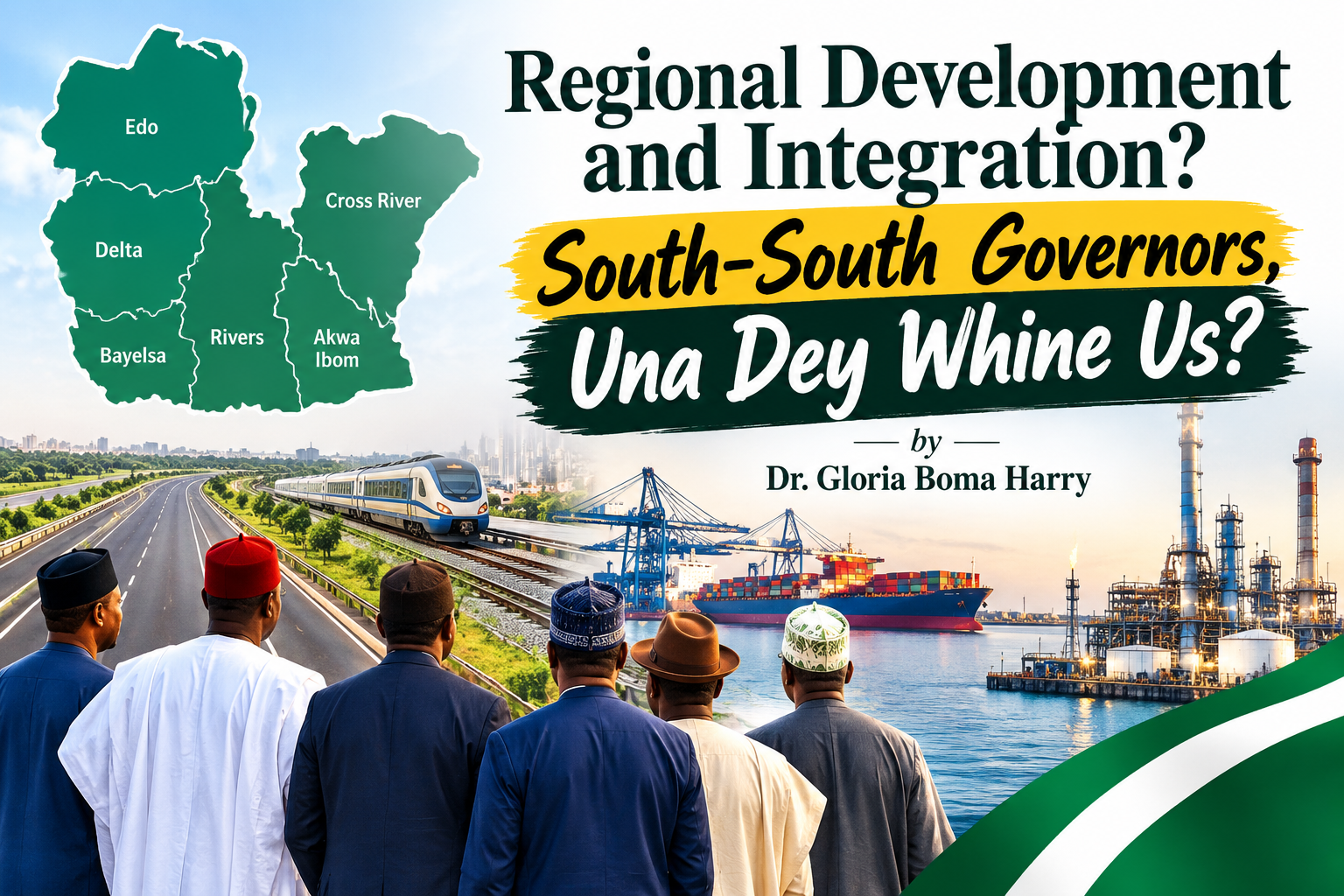
The governors of Akwa Ibom, Bayelsa, Cross River, Delta, Edo and Rivers states converged recently under the South-South Governors’ Forum to announce an ambitious plan to transform the region into one of Nigeria’s most formidable economic blocs. They have spoken of regional rail connectivity, the rehabilitation of major seaports, industrialisation, a regional economic corridor, environmental remediation and the development of the South-South as a gas-industrial and maritime hub.
On the face of it, these are laudable ambitions. Indeed, nobody who genuinely desires the development of the South-South should oppose such initiatives. But there is a rather uncomfortable question that citizens are entitled to ask: Why now?
These governors are already several years into their respective administrations, and some are approaching the final stretch of their four-year mandates. Why are we only now hearing about a grand regional development agenda of this magnitude?
Major infrastructure projects do not emerge overnight. Rail networks require years of planning, feasibility studies, financing, land acquisition and construction. Seaport rehabilitation requires substantial capital and institutional coordination. Industrial corridors require infrastructure, investment incentives, policy consistency and security. So, where was this vision when these governors took their oaths of office?
Development or election-season rhetoric?
The timing becomes even more curious given the political climate. The 2027 elections are approaching, political alignments are shifting and electoral activities are already beginning to gather momentum. At precisely this point, the South-South Governors’ Forum is unveiling an ambitious regional transformation agenda while simultaneously pledging “100 per cent” support for President Bola Tinubu’s re-election.
That coincidence deserves scrutiny. Is this genuinely a carefully developed regional economic strategy, or are citizens being presented with another political manifesto when what they need are completed projects, functioning institutions and measurable results?
There is nothing wrong with governors discussing the future. In fact, they should. But governance is not primarily about announcing what will be done tomorrow; it is about demonstrating what has been done today.
Citizens should therefore be asking: How many of these projects have feasibility studies? How much funding has been committed? What are the implementation timelines? Which institutions will execute them? What percentage of the projects will be funded by the states, the Federal Government or private investors? And, most importantly, what can citizens realistically expect to see before these administrations leave office?
Without clear answers, the grand declarations risk becoming another collection of political promises destined to disappear with the campaign season.
We have heard this before
The South-South has no shortage of development plans, regional bodies, commissions and political meetings. What the region has often lacked is sustained implementation.
For decades, the Niger Delta has remained central to Nigeria’s economic survival while many of its communities continue to struggle with poor infrastructure, environmental degradation, unemployment, insecurity and inadequate social services.
The region has produced enormous wealth for Nigeria. Yet, in many communities, basic development remains painfully inadequate.
Governor Douye Diri himself acknowledged this contradiction when he noted that the region cannot continue to produce wealth while its communities remain surrounded by environmental devastation. That statement captures the central challenge perfectly. The South-South does not need another beautiful communiqué. It needs delivery.
It needs roads that work, reliable electricity, functional seaports, efficient transport networks, quality schools, modern healthcare facilities, jobs, security and an environment capable of supporting sustainable economic activity.
A regional bloc is a good idea—but prove it
The idea of transforming the South-South into an integrated economic powerhouse is not only desirable; it may be necessary.
The six states possess enormous economic advantages. Oil and gas resources, a vast coastline, agricultural potential, maritime assets, tourism opportunities, human capital and strategic access to regional and international markets give the South-South considerable economic leverage. But these advantages will remain largely theoretical without coordination and implementation.
A truly integrated South-South should not merely hold quarterly meetings. It should develop a binding regional economic plan with measurable targets, transparent financing arrangements and publicly accessible progress reports.
If the governors are serious, they should publish the regional development blueprint. Let citizens see the projects. Let them see the budgets. Let them see the timelines. Let them see who is responsible for implementation. And let us judge them by results.
So, una dey whine us?
This is where the Nigerian expression in the headline becomes particularly relevant. “Una dey whine us?” In plain English: Are you trying to deceive us?
It is not an accusation that the governors are incapable of developing the region. Neither is it an argument against regional integration. Rather, it is a legitimate question about credibility, timing and political sincerity.
Citizens have become increasingly sophisticated. They can distinguish between a policy announcement and a project on the ground.
If these governors genuinely believe that the South-South can become Nigeria’s most formidable economic bloc, then they should demonstrate it, not merely tell us. If the regional rail network is feasible, show us the plan. If the ports are to be rehabilitated, show us the financing. If industrialisation is the goal, show us the investors. If the region is to become a gas-industrial hub and maritime gateway, show us the roadmap. And if environmental restoration is a priority, show us the projects and the money committed to them.
Most importantly, do not wait until another election season to remind citizens of what could have been done during your tenure. The South-South deserves development, not development rhetoric. It deserves integration, not political declarations. And its people deserve leaders who understand that governance is measured not by the number of communiqués issued, but by the number of lives transformed.
The governors may have a compelling vision. They now have to convince a sceptical public that it is more than an election-year promise.
Until then, one question will continue to linger: Regional development and integration? South-South Governors, una dey whine us?
Dr Gloria Boma Harry writes from Port Harcourt, Rivers State.
Email: gloriab4real@gmail.com










Leave a comment