
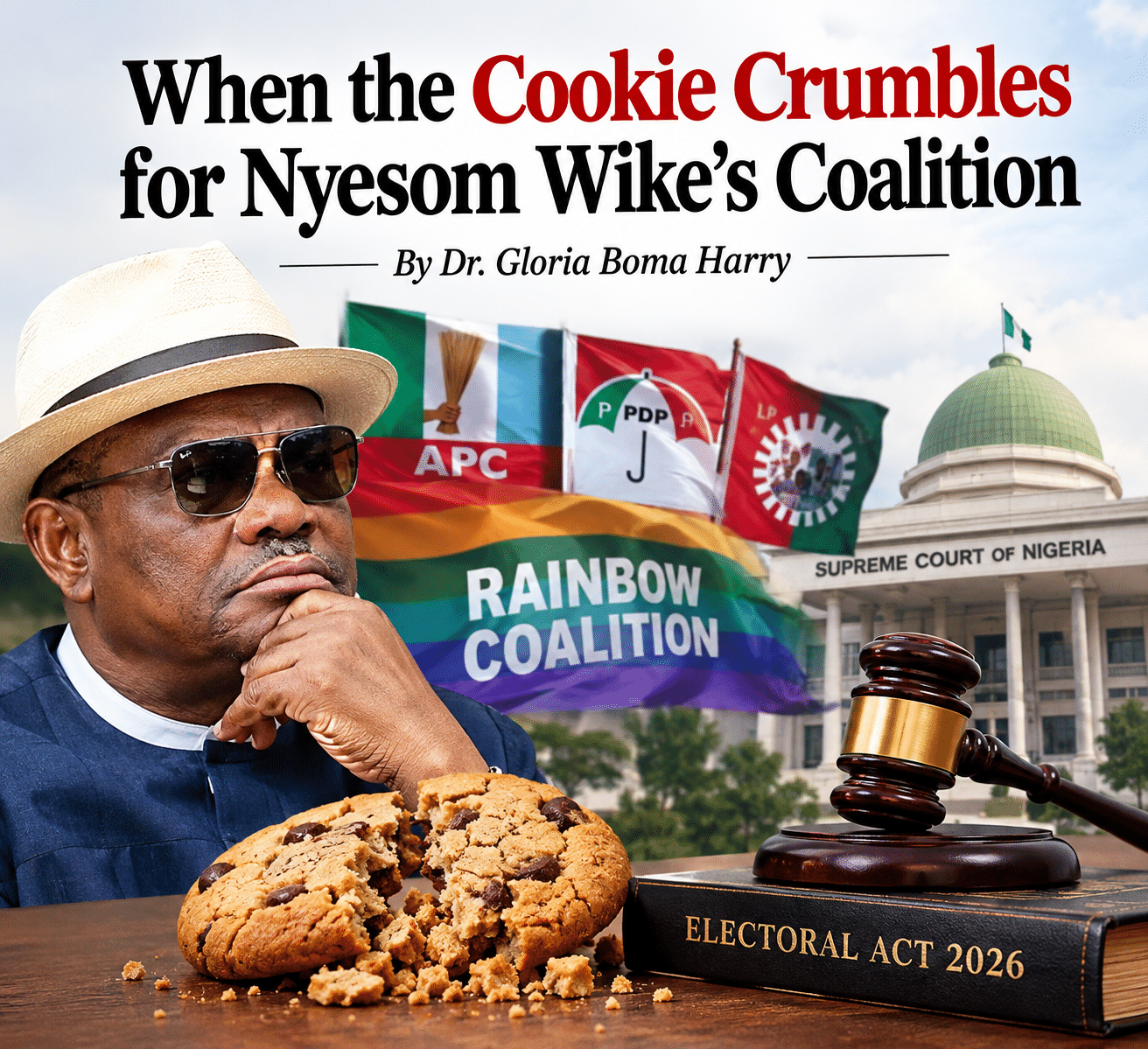

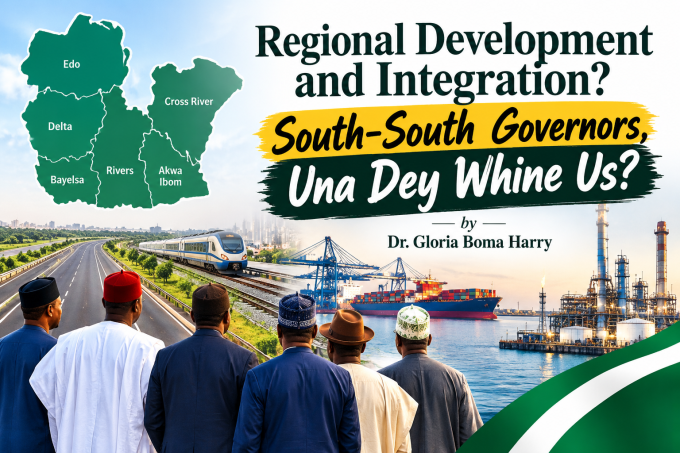
By Dr. Gloria Boma Harry
Politics is often described as the art of the possible. But elections are not won by political mathematics alone. They are won within the boundaries of the law. And that is where Nyesom Wike’s Rainbow Coalition may be approaching its most uncomfortable test.
The coalition is now facing two interconnected challenges in Rivers State: a Supreme Court ruling reinforcing statutory requirements for party membership and candidate nomination, and a Court of Appeal decision leaving in place a High Court order that nullified the Rivers APC congresses which produced the Tony Okocha-led executive.
Together, the developments have put the legal machinery behind the coalition’s 2027 strategy under scrutiny.
The Port Harcourt Division of the Court of Appeal has affirmed the jurisdiction of the Rivers State High Court in the dispute over the APC congresses that produced the Tony Okocha-led executive.
The matter began on December 20, 2024, when Justice Godswill Obomanu of the Rivers State High Court issued an ex parte order restraining the APC from conducting its ward, local government and state congresses in Rivers State. The congresses nevertheless went ahead, producing Okocha and other members of the state executive.
The rival faction subsequently returned to the High Court and sought the nullification of the congresses on the ground that they had been conducted in defiance of the subsisting court order. The High Court granted the application and nullified the congresses.
Okocha and members of his executive appealed, arguing that the High Court lacked jurisdiction to issue the original restraining order.
In a judgment delivered by Justice Elfreida Williams-Dawodu, JCA, the Court of Appeal rejected that jurisdictional challenge and dismissed the appeal as incompetent.
That is the precise holding. The appellate court did not, in that decision, pronounce that every candidate subsequently produced by the Okocha-led structure is automatically invalid.
Nor did it finally determine the substantive dispute over the Rivers APC leadership. Rather, its decision left the High Court’s order nullifying the congresses standing. The Rivers APC has itself maintained that the appeal was interlocutory and that the substantive case remains before the trial court.
That distinction is important. But so is the fact that the congresses that produced the Okocha-led executive remain nullified by the High Court order which the Court of Appeal declined to overturn. And that inevitably raises questions about the status of decisions taken by that structure.
This is where the ruling intersects with Wike’s political project. Kingsley Chinda is at the centre of the coalition’s Rivers governorship strategy. He emerged as the APC’s governorship candidate after other aspirants, including Governor Siminalayi Fubara, Tonye Cole and George-Kelly Alabo, withdrew from the contest.
Fubara subsequently endorsed Chinda and declared support for the Wike-led Rainbow Coalition. Politically, the arrangement is significant. Legally, however, endorsement is different from nomination.
And nomination depends on a political party and the validity of the processes through which that party selects its candidates.
The Supreme Court has separately restored statutory provisions requiring political parties to maintain and submit membership registers and governing participation in party primaries and candidate nomination.
The significance is straightforward: a coalition can endorse a candidate, but it cannot substitute itself for the political party through which that candidate must legally contest.
That makes the status of the Rivers APC structure an important question.
If the congresses that produced a particular party executive remain nullified, what is the legal effect of decisions subsequently taken by that executive?
That question is not answered by the Court of Appeal judgment itself. It will depend on the substantive proceedings, the precise court orders and any further judicial decisions. But it is now a question the coalition cannot afford to ignore.
The legal uncertainty comes against the backdrop of an increasingly open political disagreement between Wike and some APC governors.
The APC Governors’ Forum has said it will support the party, its candidates and President Bola Tinubu’s 2027 re-election bid, distancing itself from political arrangements it considers capable of weakening the APC.
Wike, meanwhile, has maintained that the Rainbow Coalition is intended to mobilise support for Tinubu at the presidential level while allowing politicians to pursue governorship and legislative contests on their respective party platforms.
He has also said he never promised that the PDP would refrain from fielding candidates against APC candidates in 2027. That exposes the fundamental tension. Wike’s coalition is cross-party. The APC’s electoral machinery is party-based. And the governors are insisting on the primacy of the APC structure.
The equation becomes even more interesting with reports that President Bola Tinubu is moving to give Wike a defined role in the 2027 presidential campaign structure, with the former Rivers governor expected to coordinate campaign activities in Rivers State and the FCT.
If implemented, the arrangement would give Wike a formal presidential campaign responsibility in the two territories where he has repeatedly asserted considerable political influence.
It would also place him at the intersection of the Rainbow Coalition and the formal presidential campaign structure.
Wike remains a PDP member, while serving as FCT Minister under an APC-led Federal Government.
The arrangement therefore presents an unusual political configuration: a PDP politician helping to mobilise support for an APC presidential candidate while APC governors insist that the party’s own structures and candidates must remain central to the campaign.
For the Rainbow Coalition, Rivers is where political alliances now meet institutional and legal questions. Wike and Fubara have moved from political confrontation to cooperation. Fubara has endorsed Chinda. Wike is seeking to mobilise support for Tinubu. The APC governors are asserting the authority of the party structure.
And the courts have now reinforced the importance of lawful party processes while leaving the status of the disputed Rivers APC congresses under judicial consideration.
The result is a much more complicated political landscape than a simple alliance of personalities. The coalition may have the political agreement of influential actors, but candidates still require valid party structures and lawful nomination processes.
It would therefore be premature to declare Chinda’s candidacy invalid on the basis of the Court of Appeal ruling. The judgment does not say that. But it would be equally premature to dismiss the ruling as irrelevant. The court has left standing the High Court order nullifying the congresses that produced the Okocha-led executive.
That creates a legitimate legal question over the status of decisions subsequently taken by that structure, including any decisions connected with candidate selection. The answer will ultimately come from the courts and the applicable electoral law, not from political endorsements. That is the point at which the Rainbow Coalition’s political strength meets the hard mechanics of electoral law.
The greater test may come as the coalition moves from presidential mobilisation to actual electoral tickets. Presidential support is one thing. Governorship tickets are another. Senatorial seats are another. House of Representatives seats are another. State Assembly seats are another.
A coalition can agree on Tinubu at the presidential level and still encounter disagreements over other contests. It can unite former political adversaries and still face competing ambitions.
And it can command political influence while confronting legal questions over the party structures through which candidates must emerge. That is where the beautiful colours of the Rainbow could begin to look rather different.
The Rainbow Coalition may have political weight. Wike may have an important role in Tinubu’s presidential mobilisation. Tinubu may seek to utilise Wike’s political network in Rivers and the FCT. The APC governors may continue to insist on the authority of the party and its candidates.
And the courts may still determine important questions concerning the Rivers APC structure and its consequences for subsequent party decisions.
So the question facing the Rainbow Coalition is no longer simply: Who supports Wike? It is: Which party structure is legally recognised? Who is authorised to conduct the relevant party processes? Who conducted the primary? Under what procedure? Who nominated the candidate? And can those steps withstand judicial scrutiny?
The coalition may have the colours, the personalities and the endorsements. But when the cookie finally crumbles, the ballot paper will not ask who stood beside whom. It will ask a much colder question: Was the candidate validly nominated under the law? And that is a question no Rainbow can answer with political colour alone.
Dr. Gloria Boma Harry writes from Port Harcourt, Rivers State (gloriab4real@gmail.com)








Leave a comment