
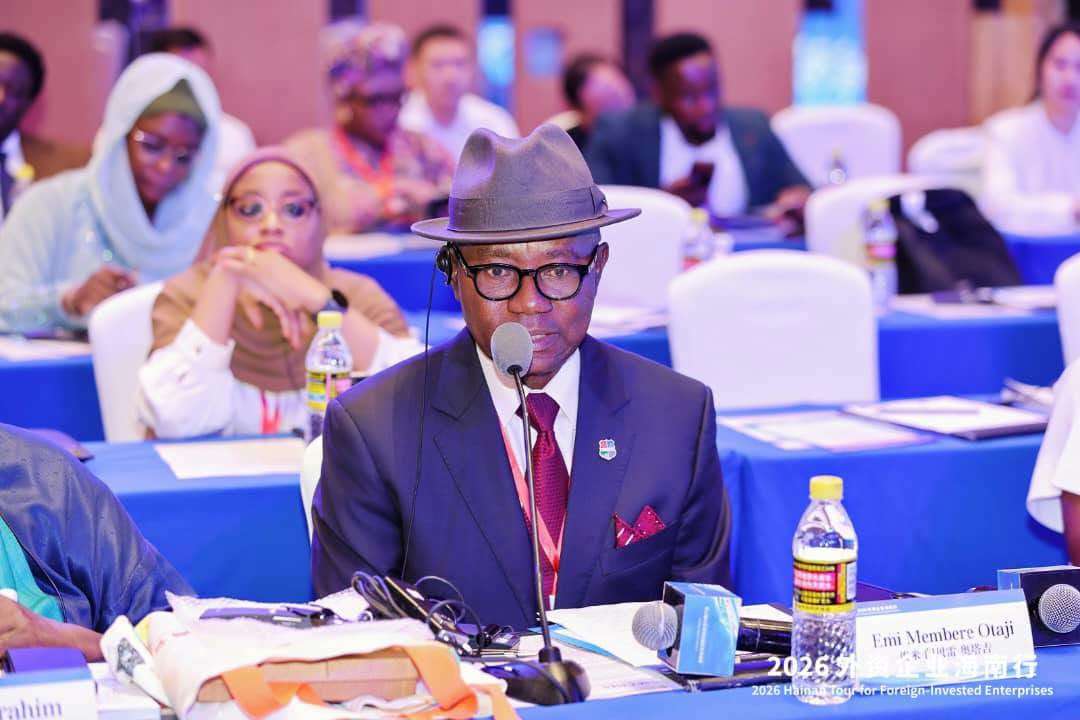

Nigerian business leader, Alabo Dr Emi Membere-Otaji, OON, has called on Chinese and other international investors to take advantage of Nigeria’s vast economic opportunities, describing the country as a strategic gateway to the West African market and the wider African continent.
Africa Update reports that Membere-Otaji made the appeal while presenting a Nigerian enterprise investment pitch at the 2026 Hainan Tour for Foreign-Invested Enterprises, held alongside the Hainan Free Trade Port International Investment Cooperation Promotion Conference and the Hainan-Shanxi Cooperation programme in China.
In his presentation titled “Why Invest in Nigeria”, the renowned entrepreneur highlighted Nigeria’s large population, youthful workforce, strategic geographical location and access to expanding African markets as compelling reasons for foreign investors to establish or expand their businesses in the country.
He put Nigeria’s population at approximately 250 million, describing its young and educated population as a significant market and an important source of human capital for investors.
He also emphasised Nigeria’s strategic position within the 16-country West African subregion and its access to the African Continental Free Trade Area (AfCFTA), which provides access to a continental market of approximately 1.5 billion people.
“There is no better time to invest in Nigeria,” he declared, pointing to what he described as steady economic growth, easing inflationary pressures and relative stability in the foreign exchange market.
According to him, improvements in the availability of economic data, particularly information regularly published by the National Bureau of Statistics, alongside the digitalisation of government processes, are helping to create a more transparent and predictable business environment.
Membere-Otaji also identified improvements in tax administration, the harmonisation of taxes and levies, and incentives such as Pioneer Status tax holidays for qualifying investments as additional attractions for prospective investors.
Highlighting developments in Nigeria’s maritime sector, the business leader said the commercialisation of port services through public-private partnership arrangements had improved operational efficiency, turnaround times and the experience of port users.
He cited the participation of major international terminal operators, including Mediterranean Shipping Company (MSC), A.P. Moller-Maersk and COSCO, as evidence of continued international interest in Nigeria’s maritime industry.
He also drew attention to the establishment of the Nigerian Ports Economic Regulatory Agency, describing the regulatory development as important for protecting the interests of importers, exporters, shipping companies and port and terminal operators.
Membere-Otaji further noted that regulated digital payment platforms were simplifying cross-border transactions, making it easier for international businesses to conduct commercial activities in Nigeria.
He identified the Nigerian Investment Promotion Commission (NIPC), Nigerian Export Promotion Council (NEPC), state investment promotion agencies and the Nigerian Association of Chambers of Commerce, Industry, Mines and Agriculture (NACCIMA) as important institutions capable of assisting foreign investors with business information, regulatory guidance and access to credible local partners.
He particularly emphasised NACCIMA’s role as the umbrella body and voice of Nigeria’s organised private sector, noting its extensive connections with government institutions and business organisations across the country.
Outlining the country’s investment potential, Membere-Otaji identified eight major sectors where significant capital, technology and expertise are required to unlock economic opportunities.
In agriculture and agribusiness, he highlighted fisheries, trawling, aquaculture, crop production and agro-processing, particularly in cocoa, ginger, soya beans and economic tree crops.
He said investments in these areas could strengthen food production, expand export opportunities, promote value addition and create employment across agricultural value chains.
On power and renewable energy, he identified generation, transmission and distribution as critical areas requiring substantial investment, particularly as reliable electricity remains essential to industrialisation and economic expansion.
He also drew attention to Nigeria’s solid mineral resources, including lithium and gold, urging investors to explore opportunities in mining, processing and related industrial activities.
In manufacturing, he identified industrial parks, free trade zones and economic zones as important platforms for establishing production facilities and expanding industrial capacity.
He described technology, healthcare and urban development as emerging investment frontiers, citing opportunities in financial technology, digital healthcare, data centres, innovation hubs, affordable housing, pharmaceutical production and diagnostic services.
He also identified urban waste management and waste-to-wealth initiatives as areas with considerable investment potential, particularly in rapidly growing Nigerian cities.
On maritime and transportation development, Membere-Otaji said Nigeria’s coastal geography and extensive maritime assets offered significant opportunities in the blue economy.
He identified ship ownership, shipbuilding, vessel repairs, port and terminal development, logistics and related maritime services as areas where foreign investors could establish profitable partnerships with Nigerian businesses.
He described the oil and gas industry as another major investment destination, stressing that opportunities existed across the upstream, midstream and downstream segments.
According to him, investors could explore opportunities in petrochemicals, fertiliser production, gas pipelines, liquefied natural gas (LNG), compressed natural gas (CNG), construction and associated energy infrastructure.
He said government policies promoting gas monetisation under the Decade of Gas initiative, alongside Nigeria’s broader energy transition agenda, were creating opportunities for investments of different sizes and scopes.
Infrastructure development and maintenance, he added, remained critical areas where the country’s investment deficit presented considerable opportunities for both local and international investors.
Membere-Otaji observed that several Chinese companies were already operating in different sectors of the Nigerian economy, with some establishing new businesses and others investing in existing enterprises to expand their operations.
He encouraged more Chinese investors to explore partnerships with Nigerian businesses, assuring them that credible local entrepreneurs were available to facilitate market entry, business development and investment expansion.
“As a local investor in Nigeria, I can confidently tell you, come in, the coast is open, the gaps are huge, return on investments attractive. Vetted and reliable local investors will be ready to hold your hands and walk the journey with you,” he said.
He concluded his presentation with a renewed appeal to international investors, declaring: “The time to invest in Nigeria is now.”
Meanwhile, developments following the Hainan investment conference indicate that Nigeria’s private sector delegation is already pursuing practical business partnerships with Chinese companies.
On November 6, 2026, a delegation of NACCIMA, led by its National President, Engr. Jani Ibrahim, visited the Grand China Aviation Maintenance Company Limited (GCAM) in Haikou, Hainan Province, to explore investment opportunities in Nigeria’s aviation industry.
The discussions focused on possible aircraft maintenance investments, technology transfer, technical training for Nigerian youths and improved air connectivity between Nigeria and China.
The NACCIMA president also encouraged the Chinese company to consider establishing a presence in Nigeria, citing the country’s large population and growing aviation market.
In a related development, Ibrahim called on Nigerian businesses to take advantage of Hainan’s free trade arrangements, including zero-tariff policies and other incentives, to expand non-oil exports to China and wider Asian markets.
He also proposed the establishment of a Nigerian warehouse in Hainan and a corresponding Chinese warehouse in Nigeria to facilitate trade, processing and distribution.
The engagements underscore growing efforts by Nigerian business organisations to translate international investment conferences into practical commercial partnerships, technology transfer and employment opportunities.
For Membere-Otaji, Nigeria’s investment appeal lies not only in its vast natural resources and consumer market but also in the opportunities to develop productive industries, strengthen infrastructure, create jobs and expand trade across Africa.
His presentation therefore reinforces the growing call for international investors to look beyond Nigeria’s challenges and recognise the significant opportunities available in its emerging economic sectors.












Leave a comment