
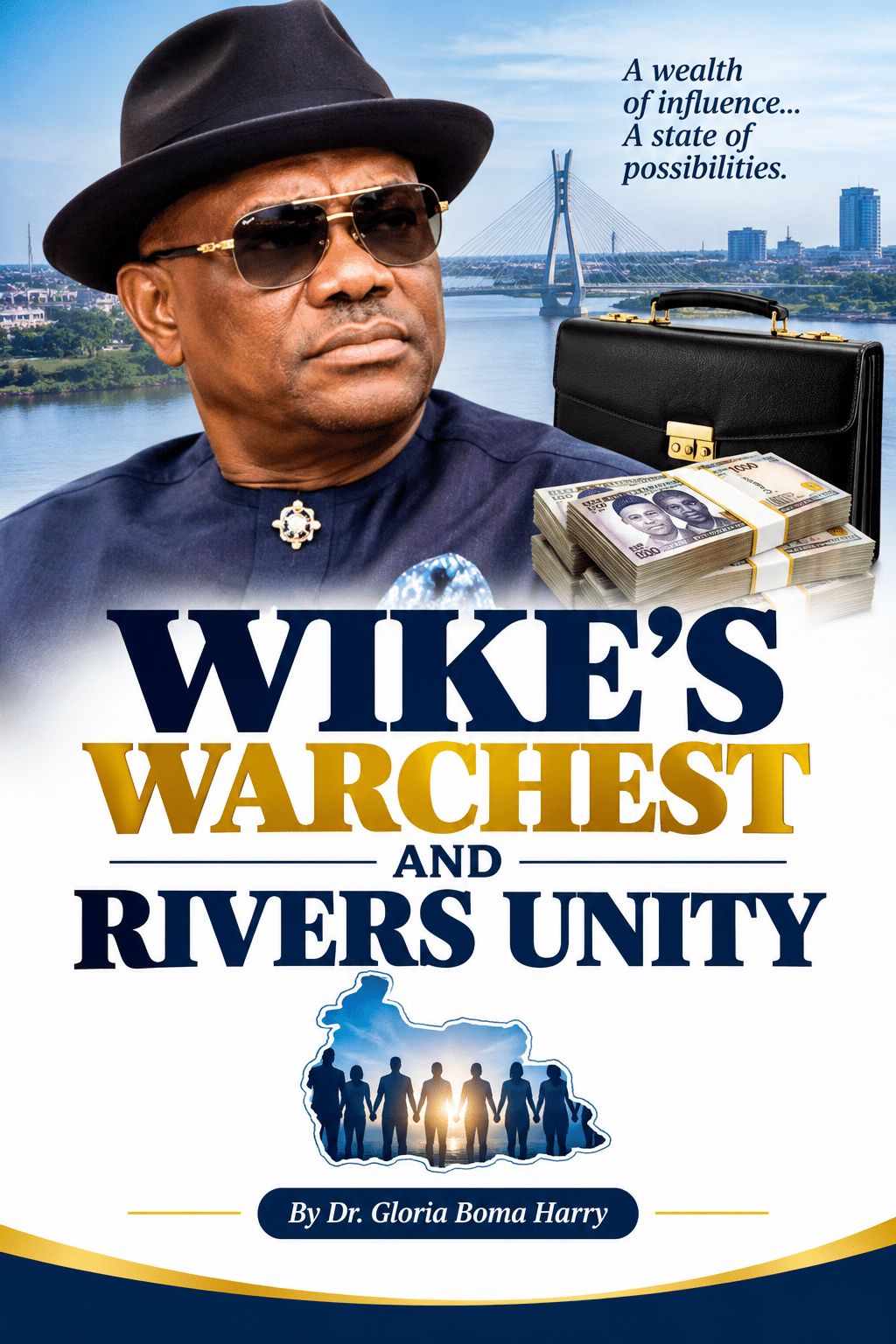

By Dr. Gloria Boma Harry
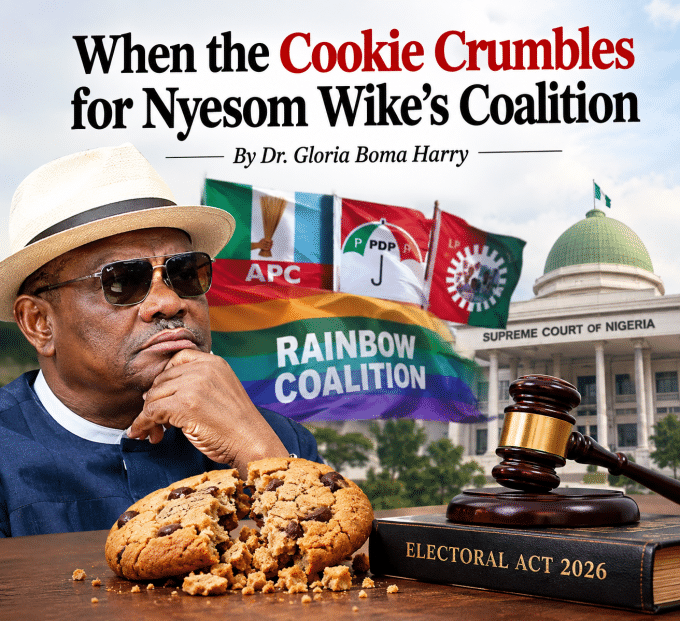
As Rivers State inches towards the 2027 general elections, the Rainbow Coalition associated with the Minister of the Federal Capital Territory, Nyesom Wike, presents a compelling political question: is it a genuine platform for Rivers unity or a strategic alliance designed to consolidate political power?
The coalition’s growing visibility, its reported reconciliation of previously opposing political interests and its unveiling of preferred candidates have intensified debate about its objectives. Yet beneath the public displays of solidarity lie three issues that demand serious scrutiny: the economic hardship confronting Rivers people, the alleged marginalisation of some coalition partners and the unresolved legal disputes surrounding the APC and PDP.
Ultimately, the question is not how formidable Wike’s political warchest may be, but what the coalition intends to deliver to the people.
The Warchest Versus the People’s Welfare
Wike remains an influential figure in Rivers politics, with extensive political connections and experience in electoral mobilisation. His association with the Rainbow Coalition places him at the centre of an alliance seeking to influence the political direction of Rivers State and support President Bola Ahmed Tinubu’s re-election bid.
But political influence is not synonymous with public confidence, and financial resources cannot substitute for a convincing response to citizens’ concerns.
Across Nigeria, the consequences of rising living costs, expensive transportation, food prices and mounting business expenses continue to shape household decisions. Although official inflation figures have moderated, many families still struggle to translate their earnings into an acceptable standard of living.
Rivers people are not insulated from these pressures. For traders, civil servants, artisans, transport operators and unemployed youths, political realignments mean little if they do not lead to better economic opportunities and improved living conditions.
The coalition must therefore answer a fundamental question: what tangible benefits will Rivers people derive from the political arrangement beyond the pursuit of electoral victory?
If its objective is to secure another term for Tinubu, its leaders should explain how they assess the administration’s economic record and what measures they will advocate to address the hardship confronting their constituents. Political loyalty should never become an excuse to avoid accountability.
Rainbow Coalition: Who Gets the Tickets?
Perhaps the most contentious question surrounding the coalition is the reported exclusion of candidates from some political parties said to be part of the alliance.
Reports on the coalition’s 27 October 2026 candidate unveiling indicated that its preferred candidates were drawn from the APC and PDP, despite the reported participation of politicians associated with other parties.
The reported distribution of 49 preferred candidates; 34 from the APC and 15 from the PDP, raises legitimate questions about the terms of the partnership.
Where, for instance, do the Labour Party, Action Alliance, All Progressives Grand Alliance, Allied Peoples Movement and Boot Party stand in the arrangement?
Their participation in a coalition does not automatically guarantee them electoral tickets. Nevertheless, if they are expected to contribute their structures, supporters and political influence, the terms of their participation deserve clarification.
Did they freely agree to support candidates from the APC and PDP? Were their interests accommodated through other negotiated arrangements? Or are there disagreements that have yet to become public?
These questions should not be answered through speculation. The coalition’s leadership and the parties concerned should provide clarity. A coalition cannot convincingly preach unity while leaving its partners uncertain about their place in the alliance.
The issue is not whether every party must receive a ticket, but whether the process is transparent, fair and consistent with agreements reached among the participants. Without clarity, the appearance of unity may conceal competing interests that could become more difficult to manage as the election approaches.
Legal Battles: The Uncertainty Beneath the Alliance
The coalition’s political calculations are unfolding against a complicated legal landscape.
The APC in Rivers State has faced litigation over disputed congresses and the legitimacy of its state executive structure. The PDP, meanwhile, has endured prolonged leadership disputes, including court proceedings concerning its November 2025 convention and the recognition of rival leadership arrangements.
These disputes are not merely internal party affairs. They can affect the legitimacy of decisions, compliance with nomination procedures and the legal standing of candidates seeking elective office.
The Independent National Electoral Commission’s requirements and the applicable electoral laws will ultimately determine whether parties and candidates satisfy the necessary conditions. Political endorsements cannot override judicial decisions or statutory obligations.
For the Rainbow Coalition, this creates a practical challenge: its preferred candidates must emerge through processes that are legally defensible, not simply politically convenient.
The coalition may present itself as a united front, but unresolved disputes within its constituent parties could complicate that objective. The prudent course is to respect judicial processes, clarify party positions and avoid treating political announcements as substitutes for legal certainty.
Rivers Unity: Beyond Wike and Fubara
The reported rapprochement between Wike and Governor Siminalayi Fubara has added another dimension to Rivers State’s evolving political landscape. Their alignment around the coalition and Tinubu’s re-election could reduce tensions between previously opposing political camps.
However, reconciliation among political leaders should not be mistaken for unity among the people.
For ordinary residents, genuine unity means functioning public institutions, improved roads and drainage, employment opportunities, security, responsible management of public funds and a political environment in which disagreement does not invite hostility.
Rivers people need a political settlement that serves the public interest, not merely one that accommodates influential individuals.
The coalition must also recognise that political pluralism is not the enemy of unity. Smaller parties, opposition groups, civil society organisations and independent voices have legitimate roles in a democracy. Their participation should not be reduced to a mobilisation strategy without meaningful engagement in decision-making.
2027: The Real Test
The 2027 elections will test more than the organisational capacity of the Rainbow Coalition. They will test the credibility of its promises, the transparency of its arrangements and the ability of political parties to resolve disputes within the law.
Rivers voters should look beyond political endorsements, campaign gatherings and the financial strength of competing camps. They should examine candidates’ records, policies, qualifications and commitment to public accountability.
The coalition must explain how it intends to address economic hardship, accommodate the interests of its participating parties and ensure that its candidates satisfy all applicable legal requirements. Other political platforms must equally present credible alternatives rather than rely solely on criticism of their opponents.
No political alliance should be presumed to represent the entire electorate simply because prominent leaders have reached an agreement. Equally, no candidate should be dismissed without examining the substance of their proposals and record.
The election outcome remains uncertain, and it would be premature to declare any political camp victorious before the electorate has spoken.
Whose Unity, Whose Interest?
Wike’s warchest may strengthen political organisation, but money alone cannot guarantee trust. A coalition may unite powerful figures, but that does not automatically resolve economic hardship, party divisions or questions of representation.
The Rainbow Coalition now faces a defining challenge: to demonstrate that its unity extends beyond political negotiations and serves the wider interests of Rivers State.
If some participating parties have been left without candidates, the terms of their involvement deserve explanation. If legal disputes threaten the standing of party structures or nominations, they must be resolved through lawful processes. And if the coalition seeks public support for Tinubu’s re-election, it must confront the economic concerns of the people it hopes to mobilise.
Rivers unity must mean more than the unity of political leaders. It must mean a shared commitment to the welfare, dignity and future of the people.
As 2027 approaches, the decisive question is not who controls the biggest warchest, commands the loudest political machinery or assembles the most prominent allies. It is who can offer credible answers to the challenges confronting Rivers people.
That is the standard by which the Rainbow Coalition and every competing political platform should be judged.
Dr. Gloria Boma Harry (gloriab4real@gmail.com) , writes from Port Harcourt the Rivers State capital.










Leave a comment