

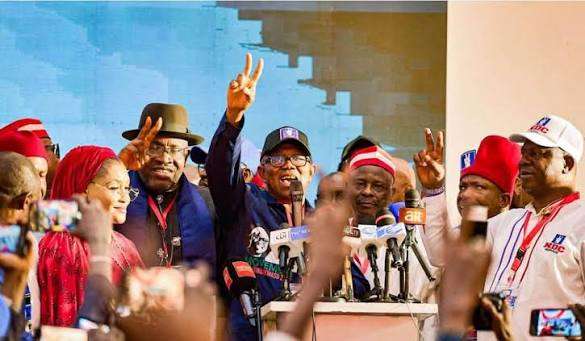
The Labour Party (LP) in Rivers State has declared a definitive end to its internal leadership crisis, asserting that the era of factionalism has been extinguished following a successful state congress held in Port Harcourt on April 25.
The party’s standard-bearer in the 2023 gubernatorial election, Beatrice Itubo, made this proclamation while addressing journalists shortly after the election of a new executive committee tasked with steering the party’s affairs for the next four years.
Madam Itubo emphasised that the congress was a culmination of the party’s commitment to legal and constitutional order. She noted that the new leadership is aligned with the national committee led by Esther Nenadi Usman, which has received the requisite affirmation from both the judiciary and the Independent National Electoral Commission (INEC).
Extending an olive branch to aggrieved members, Itubo cautioned against further litigation, which she described as a drain on the party’s limited resources.
“I have been a steadfast supporter of the Nenadi Usman-led leadership,” Itubo stated. “There is no longer a faction in the Labour Party. We are one entity, and we are calling upon those who have stood apart to return so that we may build a formidable and united structure ahead of 2027.”
Addressing the common criticism that the party exists primarily within the digital sphere, Itubo pointed to its performance in the 2023 general elections as proof of its grassroots strength. While acknowledging the significant “boost” provided by Mr Peter Obi’s entry into the party, she maintained that the Labour Party remains, at its core, a platform for the working class.
“The Labour Party is a workers-based party,” she remarked, noting that the current economic climate characterised by soaring inflation and stagnant wages has made the party’s mandate more relevant than ever. “Workers are the worst hit by the present hardships. When you are sick and cannot afford medication, or when hunger pervades the home, the need for a party that represents the people becomes absolute.”
The congress was described as a “paradigm shift” from previous practices, where party officials were allegedly handpicked in private residences without democratic oversight. Delegates from all 23 Local Government Areas (LGAs) participated in the process, which saw Fredric Nwojie emerge as the substantive State Chairman.
Mr Nwojie, who previously served in an interim capacity, was praised for stabilising the party after a tumultuous period marked by the defection of the former interim chairman and his team to the African Democratic Congress (ADC).
In his inaugural remarks, Chairman Nwojie highlighted the party’s forward-thinking approach, including the introduction of electronic registration for members. He reiterated that the leadership is not driven by personal gain but by a collective struggle for a better society, stating, “We are fighting for something.”
The new executive committee emerged through a consensus process, following the formal dissolution of all previous standing committees. The event drew a significant presence from organised labour, including representatives from the Nigeria Labour Congress (NLC) and the Trade Union Congress (TUC), alongside officials from the party’s national headquarters.
As the Labour Party repositions itself, the successful conclusion of the Rivers State congress signals a renewed determination to present a credible and unified alternative in the 2027 electoral cycle.





Leave a comment