
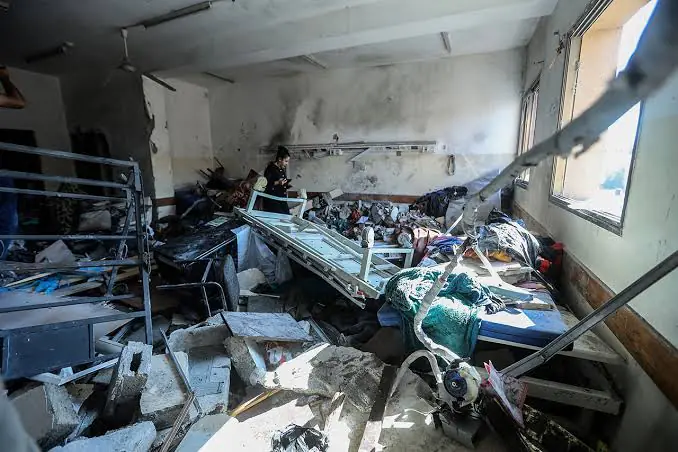

An Israeli airstrike on Nasser Hospital in southern Gaza has killed at least six people, including a surgeon and a 13-year-old boy, and injured 28 others, further worsening the humanitarian and healthcare crisis in the war-ravaged Palestinian territory.
The attack occurred shortly after midnight on Thursday, November 12, 2026, at the hospital complex in Khan Younis, according to the hospital authorities and Gaza’s Hamas-administered Ministry of Health.
The Israeli military confirmed carrying out the operation, claiming that it targeted a Hamas commander and other militants allegedly operating from within the hospital complex.
In a statement, the Israel Defence Forces (IDF) alleged that Hamas had established a presence within the medical facility and was using it as a command centre for military and terrorist activities.
However, the military did not provide publicly verifiable evidence to substantiate the allegation. Hamas rejected the accusation, describing the attack as a war crime.
According to Gaza’s Ministry of Health, the strike hit the second floor of the hospital’s surgical wing, one of the facility’s principal buildings, which houses the surgery department and intensive care unit.
Among those killed was Dr Rizk Abu Shaira, a 52-year-old general surgeon who was reportedly attending to patients at the time of the bombing. A 13-year-old boy was also among the victims.
The hospital’s surgical facilities sustained extensive damage, with operating rooms, patient wards and medical equipment destroyed or rendered unusable.
Hospital authorities subsequently announced the suspension of services in four departments: radiology, laboratories, surgical operations and inpatient surgical wards.
The hospital’s director, Dr Ahmed al-Fara, said the attack had severely disrupted medical services, while the destruction further reduced access to specialised healthcare for residents of southern Gaza.
Nasser Hospital is regarded as one of the last major functioning medical facilities in the Gaza Strip, where years of conflict have devastated healthcare infrastructure, depleted medical supplies and severely limited access to essential treatment.
The attack was reportedly the seventh time the Israeli military had struck the Nasser Hospital complex since the outbreak of the war on October 7, 2023.
The attack has attracted renewed international concern over the protection of medical facilities and civilians under international humanitarian law.
The United Nations Human Rights Office in Palestine subsequently reported that three missiles were involved in the attack, although only one exploded. It put the number of injured at approximately 30, slightly higher than the initial hospital figures.
Spain’s government condemned the bombing on November 13, describing it as a serious violation of international humanitarian law and the October 2025 ceasefire agreement. It called for urgent humanitarian assistance to be allowed into Gaza.
The US President Donald Trump’s Board of Peace, which oversees the ceasefire agreement and broader peace plan, also called on Israel and Hamas to honour their commitments under the agreement.
The latest attack has raised further questions about the durability of the ceasefire, which came into effect in October 2025, amid continued Israeli military operations and recurring reports of casualties in Gaza.
The Israeli military campaign followed the Hamas-led assault on southern Israel on October 7, 2023, in which approximately 1,200 people were killed and 251 others taken hostage.
Since then, Gaza’s Ministry of Health has reported more than 74,600 Palestinian deaths and over 176,000 injuries resulting from Israel’s military operations.
The destruction of hospitals, medical facilities and essential infrastructure has left large sections of Gaza’s population struggling to access healthcare, food, clean water and other basic necessities.
The bombing of Nasser Hospital has therefore intensified concerns over the safety of healthcare workers and patients, as well as the ability of the remaining medical facilities to provide life-saving services to millions of Palestinians.
International humanitarian law affords special protection to hospitals, medical personnel and patients during armed conflicts. Medical facilities lose that protection only under specific conditions, including when they are used to commit acts harmful to the enemy, subject to applicable warnings and other legal safeguards.
The latest incident has once again brought the protection of medical institutions and civilians to the forefront of international debate over the continuing conflict in Gaza.









Leave a comment