
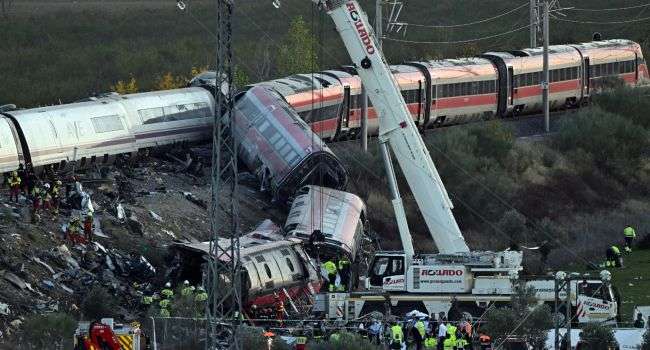

Spain’s government has declared three days of national mourning following a high-speed train collision that killed 68 people in the country’s second deadly rail disaster this year, raising fresh concerns about railway safety.
The crash occurred on Wednesday in the central province of Toledo, near the town of Urda, when a moving train collided with a stationary train from behind. Emergency workers, firefighters, police officers and soldiers were deployed to rescue survivors and recover bodies.
Prime Minister Pedro Sánchez visited the crash site and pledged a comprehensive investigation into the circumstances surrounding the collision, alongside measures to prevent further tragedies on the country’s rail network.
“It is clear that we need to reinforce the safety of our train service to rebuild the trust in our high-speed rail,” Sánchez said.
“It is not acceptable for a country like Spain to endure two high-speed train accidents in the same year.”
The three days of mourning were scheduled to begin on Thursday as the country grieved the victims of the latest disaster.
Safety system failure under investigation
Transport Minister Óscar Puente said the collision followed a computer malfunction that disrupted a security system along a 39-mile stretch of railway.
According to Puente, the system failure occurred at approximately 8.30 am, forcing trains operating along the affected section to stop. At the time, an IRYO train was stationary near Urda, while a RENFE train was approximately 15.5 miles away.
He said the central command centre subsequently instructed the RENFE train to resume movement without imposing any speed restrictions. At 8.53 am, the train collided with the stationary IRYO service.
Puente described the instruction to restart the train as “inexplicable”, arguing that it should not have been permitted to move while a stop signal remained active. He added that, even if movement had been authorised, the train should have been instructed to proceed at a reduced speed.
The minister maintained that the train drivers were not responsible for the collision, pointing instead to the system failure and the decision taken by the central command centre. The circumstances are expected to be examined as part of the investigation.
Late on Wednesday, recovery teams began using cranes to move sections of the damaged trains as emergency operations continued.
Second deadly rail disaster this year
The latest collision follows another fatal high-speed train accident in January, when 46 people died after a train derailed and struck another travelling in the opposite direction in southern Spain.
Both disasters involved services operated by the state-owned RENFE and privately owned IRYO, further intensifying scrutiny of the country’s railway system.
Spain’s high-speed rail network has long been regarded as a major national infrastructure achievement. The country has the world’s second-largest high-speed rail network by track mileage, behind China. Before this year, the network had gone more than three decades without a fatal crash of this kind.
Puente also faced questions about whether he would resign following the second major accident during his tenure. He said his immediate priority was managing the aftermath of the collision rather than considering his political future.
Political pressure mounts on Sánchez
The disaster has placed additional pressure on Sánchez’s government as it confronts questions about transport safety and prepares for another national election.
The prime minister, who took office in 2018, has previously faced major challenges, including the COVID-19 pandemic and the global surge in inflation. His government must now address public concerns about the reliability and safety of Spain’s railway services.
The incident comes amid an increasingly tense political atmosphere, with Sánchez facing criticism from right-wing parties over his migration policies and corruption allegations involving members of his party and his wife. Both the prime minister and his wife have denied the allegations.
Sánchez and other progressive parties had also sought to make housing affordability and rising rents central issues in the political debate after he called for early elections earlier this month.
In a post on X about an hour before news of Wednesday’s collision spread, Sánchez had written: “There are lots of reasons to be optimistic about this country.”
The tragedy has since shifted attention towards the condition of the country’s rail network and the need for accountability.
Opposition demands answers
The leader of the conservative Popular Party, Alberto Núñez Feijóo, called for a full investigation into the crash. His party cancelled its campaign events for the day in respect for the victims and their families.
“This is the moment to respect the dead, the injured and their families,” Núñez Feijóo said.
He added that the decision did not mean ignoring the difficult questions Spaniards were asking about the disaster.
The far-right Vox leader, Santiago Abascal, adopted a more confrontational tone, criticising the government over the deaths and accusing it of failing the public.
Abascal said he would work to ensure that the government faced legal proceedings, describing it in strongly condemnatory terms.
As rescue and recovery operations continued, the immediate priorities remained identifying the victims, supporting survivors and their families, and establishing precisely how the collision occurred.
The investigation is expected to be crucial in determining responsibility and identifying any operational or technical failures that may have contributed to the disaster.





Leave a comment