
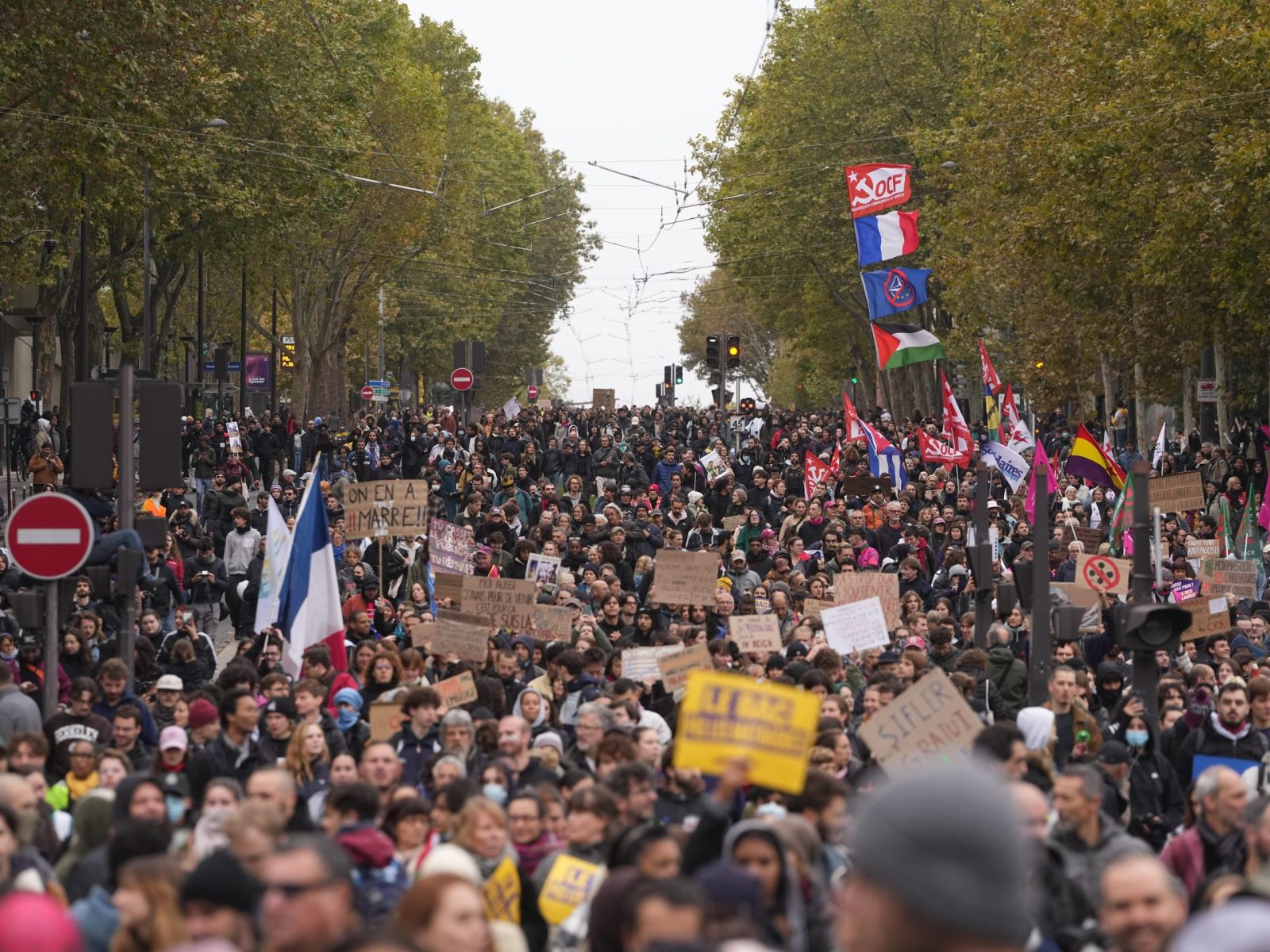

France has deployed 70,000 police officers and gendarmes across the country as demonstrations over rising living costs, education and public services entered their third consecutive weekend, with authorities warning of possible violence during Halloween celebrations.
The nationwide security operation on Saturday, October 31, 2026, was designed to prevent a repeat of the looting, vandalism and clashes that marred earlier demonstrations, particularly the unrest of October 17.
Interior Minister Laurent Nuñez described the day as carrying a very high risk of public disorder, warning that the authorities would respond firmly to any attempt to disrupt public order.
“Everyone is on deck to ensure an extremely firm response to any trouble,” Nuñez said at a news conference earlier in the week.
According to France’s Interior Ministry, the deployment involved 70,000 security personnel, including police officers and gendarmes. Specialised units, drones, helicopters, water-cannon vehicles and other security equipment were also mobilised to protect public buildings, commercial centres and residential areas. Ministère de l’Intérieur+1
Authorities had identified at least 150 planned gatherings across the country, while security measures were tightened around major cities, transport networks and shopping districts.
The coincidence of the protests with Halloween heightened concerns that some demonstrators might use masks and costumes to conceal their identities. Nuñez warned that Halloween would not provide a legitimate excuse for concealing one’s face while participating in violent demonstrations. Protests continue amid clashes
Despite the extensive security deployment, demonstrations took place in several French cities, with reports of confrontations between protesters and security personnel.
The Associated Press reported that approximately 320,000 people participated in demonstrations nationwide, while authorities made about 300 arrests. Although most of the marches were largely peaceful, isolated incidents of violence were reported towards the end of some gatherings.
In Marseille, protesters clashed with police, while demonstrators in Lyon reportedly threw objects at officers, prompting the use of tear gas. Police also deployed water cannon in Toulouse to disperse an unauthorised demonstration.
Earlier videos circulated on social media appeared to show further disturbances. Footage shared by journalist Oliya Scootercaster on X allegedly showed an object being thrown towards riot police in Paris, which she identified as a Molotov cocktail.
Another video, circulated by the X account Bleu Blanc Rouge, purportedly showed protesters attempting to break into a residential building in Marseille. However, the circumstances surrounding the footage and the identities of those involved were not independently established in the reports.
In Paris, authorities imposed restrictions on demonstrations in central areas, directing organisers towards an approved route away from major commercial districts.
A proposed march through the city centre was blocked following a legal challenge, with France’s highest administrative court upholding the authorities’ decision to permit a march from Porte de Bagnolet to Porte de Charenton instead.
Curfews were also imposed around Place de la République and Les Halles, while additional restrictions were introduced in parts of the capital to limit the possibility of further disturbances.
The security measures followed widespread damage to businesses and public property during earlier protests. Several retailers, including luxury establishments associated with brands such as Hermès and Louis Vuitton, have been targeted, while shopkeepers in parts of Paris have boarded up their premises in anticipation of further violence.
France’s Chamber of Commerce has warned of substantial financial losses arising from looting, vandalism and disruption to commercial activities.
The demonstrations initially gathered momentum among students protesting against deteriorating school conditions, inadequate educational resources and demands for reforms.
However, the movement has since expanded to include workers, trade unions and other social groups angered by rising living costs, fuel prices, borrowing costs and concerns over public services.
The government’s promises to address educational challenges and ease economic pressures have so far failed to satisfy many demonstrators.
Fifteen-year-old student Aaron Berthier de Grandry, who said he intended to participate in the protests, told Reuters that young people were increasingly concerned about the country’s future.
“When I was little, I was told young people were the future,” he said, adding that a France unable to provide adequate resources for its young population risked undermining its own future.
The unrest has also placed growing pressure on President Emmanuel Macron’s administration, with the government facing criticism over its handling of economic and social concerns.
In response, the authorities are considering tougher measures against individuals responsible for damaging property, including proposals that could make offenders liable for compensation of up to €10,000.
The United States Embassy in France has also advised American citizens to avoid areas where large demonstrations are taking place, particularly locations where violence or disruption is anticipated.
With the protests spreading beyond their original student-led campaign, the latest demonstrations underline the growing challenge facing the French government as it seeks to balance the public’s right to protest with the need to protect lives, businesses and public infrastructure.











Leave a comment