
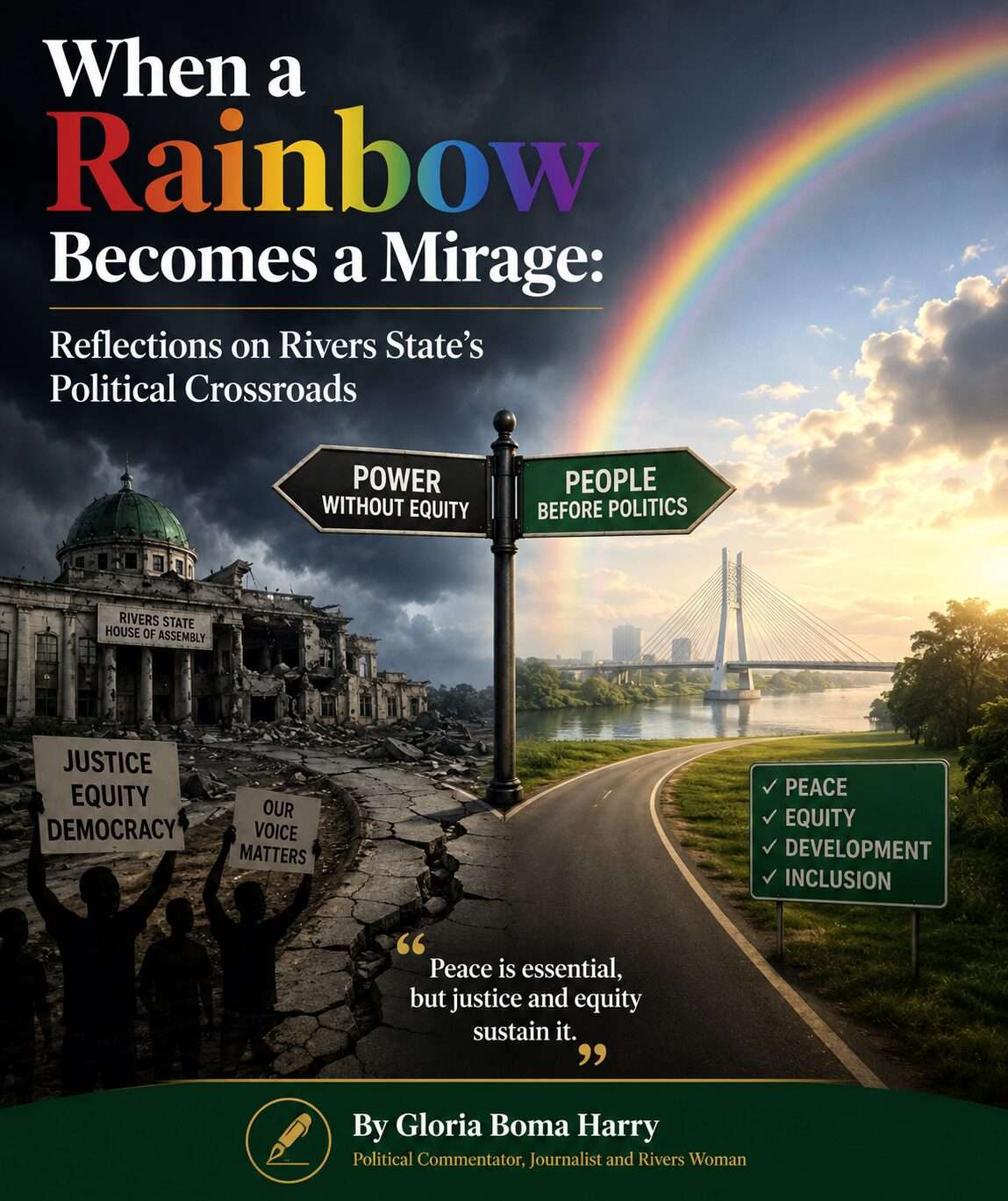

By Gloria Boma Harry
There are certain dates that become permanently etched in the political history of a people not because of natural disasters or extraordinary celebrations, but because of decisions that fundamentally alter the trajectory of governance and democratic expectations. For many Rivers people, 22 July 2026 may well become one of such defining moments.
On that day, Rivers State Governor, Sir Siminalayi Fubara, publicly declared his support for President Bola Ahmed Tinubu and the Rainbow Coalition, the political movement led by the Minister of the Federal Capital Territory, Chief Nyesom Wike. He further urged his supporters to support every candidate presented by the coalition.
Ordinarily, every politician reserves the constitutional right to determine his political association. Likewise, the governor’s call for peace after months of political turbulence is commendable. However, what has generated intense public debate is not merely his declaration of support, but the broader political implications of that decision and what it could mean for the future of Rivers State.
The political crisis that engulfed Rivers State shortly after Governor Fubara assumed office remains one of the most turbulent chapters in the state’s democratic history. Within months of his inauguration, public institutions became casualties of political conflict, most notably the Rivers State House of Assembly, whose demolition symbolised the depth of the crisis.
The prolonged struggle extended beyond political actors. It affected ordinary citizens, public servants, political appointees and party loyalists. Several individuals who anticipated reappointment or re-election reportedly found themselves excluded from political opportunities as new alignments emerged. Many who remained loyal to Governor Fubara identified with what became known as the Simplified Movement, believing they were defending not merely an individual but the principle that elected leaders should be allowed to govern without undue political interference.
Across the state, Rivers people from diverse ethnic, religious and political backgrounds rallied behind the governor. Women marched in protest, civil society organisations voiced concern, and market traders, professionals and community leaders openly demanded an end to the political impasse. For many citizens, the struggle transcended partisan politics; it became a defence of democratic governance and constitutional order.
The situation reached an unprecedented climax with the imposition of emergency rule in Rivers State for six months an extraordinary development that many citizens viewed as a significant setback for democratic governance. During this period, many residents expressed concern over the suspension of normal democratic processes and the uncertainty surrounding the state’s political future.
When Governor Fubara eventually resumed office, many Rivers people believed the worst had passed. They expected reconciliation without sacrificing the political aspirations of those who had stood firmly behind him throughout the crisis.
It is against this backdrop that his endorsement of the Rainbow Coalition has generated mixed reactions.
One of the concerns being expressed by political observers relates to the long-standing issue of equitable power rotation among Rivers State’s three senatorial districts. Since the return to democratic rule in 1999, the governorship has largely rotated between Rivers West and Rivers East Senatorial Districts.
Rivers West produced the Dr Peter Odili, who served two terms as governor. Rivers East subsequently produced Sir Celestine Omehia, Rt. Hon. Chibuike Rotimi Amaechi and Chief Nyesom Wike, resulting in an extended period of leadership from the same senatorial district.
For many stakeholders, Governor Fubara’s emergence from Rivers South-East represented an opportunity for that district to consolidate its place within the state’s rotational arrangement. Consequently, his public support for another candidate from Rivers East has raised questions about whether the principle of political equity is being compromised.
To those who hold this view, the issue extends beyond political alliances. It touches on fairness, inclusion and the preservation of the informal zoning arrangement that many believe has contributed to political stability in Rivers State over the years.
Supporters of the governor, on the other hand, argue that political reconciliation sometimes requires difficult compromises and that peace should take precedence over prolonged political confrontation. They maintain that the governor’s decision reflects statesmanship rather than surrender.
Regardless of where one stands, one reality remains undeniable: democratic leadership carries obligations that extend beyond personal political calculations. Public office is founded on a covenant of trust between elected leaders and the electorate. Every significant political decision is therefore assessed not only on its immediate benefits but also on its long-term implications for justice, equity and democratic accountability.
History has a remarkable way of judging political decisions. It remembers not only the choices leaders make but also whether those choices strengthened democratic institutions or weakened public confidence.
As Rivers State gradually emerges from one of its most challenging political periods, many citizens will continue to hope that reconciliation does not come at the expense of fairness, inclusion and the collective aspirations of the people.
Peace remains indispensable. But lasting peace is sustained not merely by political agreements, but by justice, equity and fidelity to the trust reposed by the people.
Whether the Rainbow Coalition ultimately becomes a symbol of lasting reconciliation or merely a fleeting political mirage is a verdict that only time—and history—can deliver.
Gloria Boma Harry is a political commentator, journalist and Rivers woman.











Leave a comment