
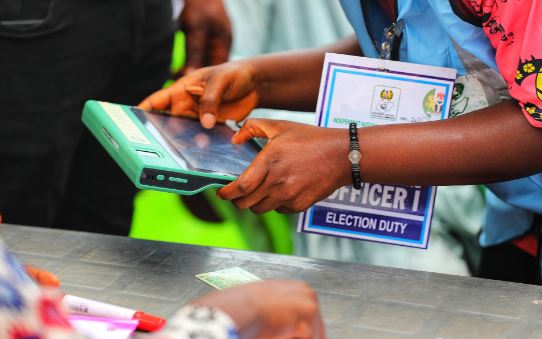

The Independent National Electoral Commission (INEC) will conduct a mock voter accreditation and election results upload exercise in 638 polling units across Rivers State on November 28, 2026, as part of efforts to test its election technology and strengthen preparations for the 2027 general elections.
The exercise, which will cover all 23 local government areas of the state, is designed to assess the efficiency of the Bimodal Voter Accreditation System (BVAS), test network connectivity and identify potential technical and operational challenges ahead of the nationwide polls.
Rivers State Resident Electoral Commissioner (REC), Dr Johnson Sinikiem, announced the development at a State-Level Stakeholders’ Meeting on the 2027 general elections held at INEC’s headquarters in Port Harcourt on Wednesday.
Sinikiem explained that two polling units had been selected from each of the state’s 319 registration areas, otherwise known as wards, bringing the total number of participating polling units to 638.
He said the exercise would enable the commission to evaluate the performance of its electoral technology under conditions similar to those expected on election day and address any shortcomings before the actual polls.
The REC called on political parties, security agencies, civil society organisations and residents to support the exercise, adding that INEC would provide further details about the selected polling units and other arrangements to ensure adequate public awareness.
Providing an update on the commission’s preparations, Sinikiem disclosed that Rivers State currently has approximately 3,736,434 registered voters spread across 23 local government areas, 319 registration areas and 6,866 polling units.
He said the commission had 6,399 fully functional and configured BVAS devices, while additional equipment would be supplied from its national headquarters to ensure adequate coverage of polling units and provide backup devices where necessary.
On the collection of Permanent Voter Cards (PVCs), the REC disclosed that INEC had received 173,241 cards in different batches ahead of the elections.
Of this number, 99,381, comprising previously uncollected and newly printed PVCs, had been collected by their owners as of Tuesday, November 17.
He appealed to eligible voters who had yet to collect their cards to visit the appropriate INEC offices in their respective local government areas.
Sinikiem particularly urged residents whose PVCs were ready for collection not to delay, stressing the importance of obtaining the cards ahead of the elections.
Beyond preparations for the mock exercise, the REC said INEC had taken delivery of several non-sensitive election materials, including voting cubicles, mats, ballot boxes and other operational equipment.
He explained that the materials had been inspected, audited and distributed to the 23 local government areas for safekeeping.
He consequently called on security agencies to maintain adequate surveillance around INEC facilities to prevent theft, vandalism or damage to electoral materials before the elections.
On the recruitment of temporary election personnel, Sinikiem disclosed that the application process for ad hoc staff, which commenced on September 18, would close at midnight on Wednesday, November 18.
He identified members of the National Youth Service Corps (NYSC) as important participants in the electoral process, noting that the commission had continued engaging corps members to prepare them for their responsibilities during the elections.
The REC also revealed that INEC personnel were undergoing intensive training in electoral risk management, Election Monitoring and Support Centres, as well as the Collation Support and Result Verification System.
According to him, the programmes were designed to strengthen the commission’s capacity to identify potential threats, monitor activities at polling units, respond to emergencies and improve transparency during the collation of results.
He reaffirmed INEC’s commitment to conducting free, fair, credible, transparent and inclusive elections in Rivers State, emphasising that the success of the process would depend on the cooperation of political parties, security agencies, voters and other stakeholders.
Meanwhile, the Rivers State Police Command has announced plans to deploy more than 5,000 trained officers to maintain security before, during and after the 2027 general elections.
The Commissioner of Police, Olugbenga Adepoju, disclosed this during a separate stakeholders’ engagement on preparations for peaceful elections in the state.
Adepoju said the command had developed comprehensive security arrangements in collaboration with other agencies under the Inter-Agency Consultative Committee on Election Security.
He explained that the security plan covered the state’s 23 local government areas, 319 wards and 6,866 polling units.
According to him, joint operational plans, patrol routes and deployment arrangements had been developed to prevent electoral violence and protect voters, electoral officials and sensitive election materials.
The police commissioner further disclosed that arrangements had been concluded for round-the-clock security at INEC offices, Central Bank of Nigeria vaults and Registration Area Centres.
He said the more than 5,000 officers selected for election duties were undergoing refresher training in electoral laws, human rights and the appropriate rules of engagement to ensure that their operations complied with established legal provisions.
Adepoju also announced the establishment of an election situation room and control room to improve communication, coordinate security operations and facilitate rapid responses to incidents.
He added that dedicated telephone hotlines would be made available to enable residents to report suspicious activities and other election-related security concerns.
The commissioner said Area Commanders and Divisional Police Officers had been directed to engage community stakeholders through town hall meetings to identify local concerns and address potential security threats before election day.
He warned politicians, political parties and their supporters against activities capable of undermining the electoral process, particularly thuggery, ballot snatching, vote buying and voter intimidation.
Adepoju maintained that anyone found sponsoring or participating in electoral violence would face arrest and prosecution, irrespective of political affiliation or status.
He assured residents that adequate security arrangements would be put in place to protect voters at polling units, while urging citizens not to allow political interests to discourage them from exercising their voting rights.
The police commissioner also called on INEC to maintain transparency throughout the electoral process, particularly during accreditation, voting, transmission and collation of results.
He urged political parties and candidates to sign and enforce peace accords, discipline their supporters and focus their campaigns on issues rather than personal attacks.
Adepoju further appealed to traditional rulers and religious leaders to use their influence to discourage violence and promote peaceful political participation in their communities.
Also speaking at the stakeholders’ meeting, the National Orientation Agency (NOA) in Rivers State pledged to intensify public enlightenment campaigns ahead of the 2027 general elections.
The agency said its voter education and peace advocacy programmes would be extended to markets, schools, churches, mosques, communities and youth organisations.
The campaigns are expected to focus on discouraging vote buying, hate speech, voter intimidation, misinformation and other activities capable of threatening peaceful elections.
The State Director of NOA, Dr Edward Banigo, described the forthcoming elections as a collective national responsibility rather than an assignment exclusively reserved for INEC and political parties.
He commended the preparations undertaken by the electoral commission, security agencies, civil society organisations, the media and other stakeholders, particularly in the areas of early planning, voter education, deployment of electoral materials and the use of technology to improve transparency.
Banigo warned against allowing political differences to create divisions and violence among residents during the election period.
He said: “The 2027 general election is not just an INEC election. It is not a political party election. It is our election. And its success will depend on how prepared we are, how united we are, and how committed we are to peace.”
The NOA director stressed that credible elections would require the cooperation of political parties, candidates, security agencies, observers, the judiciary, traditional rulers, religious leaders, women and youth groups.
He urged politicians to conduct their campaigns responsibly and avoid statements or actions capable of provoking hostility among their supporters.
The stakeholders’ meeting was attended by representatives of political parties, security agencies, youth organisations, religious institutions, civil society groups and women’s organisations.
The 2027 general elections are scheduled to begin with the presidential and National Assembly elections on January 16, 2027, while governorship and State House of Assembly elections are slated for February 6, 2027.
With INEC’s planned mock accreditation exercise, the police security arrangements and NOA’s proposed public enlightenment campaigns, stakeholders are expected to intensify efforts to ensure that the forthcoming elections in Rivers State are peaceful, transparent and credible.











Leave a comment