

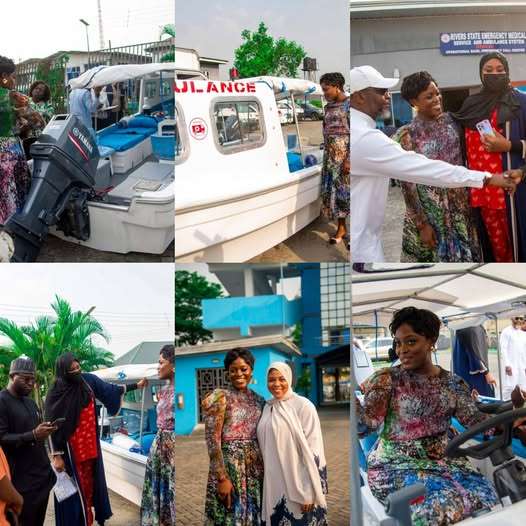

In a significant move to combat maternal and neonatal mortality within the region’s coastal territories, the Rivers State Government has formally received a state-of-the-art boat ambulance. The vessel was donated by the National Emergency Medical Services and Ambulance System (NEMSAS) to facilitate urgent medical interventions in the state’s riverine corridors.
The delegation from NEMSAS, led by Programme Manager Dr Doubra Emuren, presented the maritime asset to the Rivers State Commissioner for Health, Dr Adaeze Chidinma Oreh. This initiative forms part of a broader federal strategy to enhance the efficiency of emergency medical services, with a particular focus on the unique geographical challenges posed by the Niger Delta.
Dr Emuren noted that the provision of the ambulance is a targeted response to the high rates of maternal and neonatal mortality. By providing a dedicated corridor for emergency care on water, the government aims to ensure that no expectant mother or newborn is disadvantaged by their proximity to the mainland.
Receiving the donation on behalf of the state, Dr Adaeze Chidinma Oreh expressed her profound gratitude to NEMSAS. She underscored the transformative potential of the vessel, stating that it would “significantly strengthen” the state’s capacity to respond to crises in “hard-to-reach rural communities.”
For many years, the lack of swift transportation has been cited as a primary barrier to healthcare for riverine populations. The new boat ambulance is equipped to provide critical care in transit, serving as a mobile clinical unit that connects remote villages to tertiary health facilities.
The deployment of this asset is expected to have an immediate impact on the welfare of pregnant women and infants. By reducing the “travel time to care,” the Rivers State Government anticipates a measurable decline in preventable deaths during childbirth.
The Ministry of Health has confirmed that the vessel will be integrated into the existing state emergency dispatch system, ensuring that it is manned by trained paramedics capable of delivering life-saving stabilisation during riverine transport.









Leave a comment