
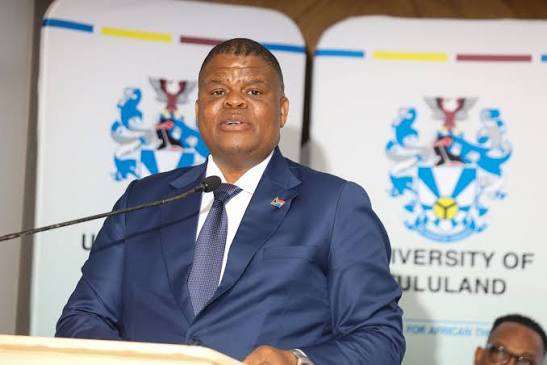

South Africa will not run out of water, but localised shortages, ageing infrastructure and unreliable supply continue to leave some communities and businesses vulnerable to water insecurity, Deputy Minister of Water and Sanitation and ANC NEC member, David Mahlobo, has warned.
Speaking at a briefing on Sunday, Mahlobo said water security had become an apex priority for the government, with measures under way to expand access, upgrade ageing infrastructure and secure the country’s long-term water supply.
“We know that it is a pressure on our water resources, but we can assure you that our country is not going to run out of water. But however, we must clarify that we do have localised deficits,” Mahlobo said.
He said access to water had increased to 91.3 per cent in 2026, while access to sanitation had reached 85.6 per cent.
However, Mahlobo stressed that access figures should not be considered in isolation from the reliability of supply, as some communities continued to experience intermittent water availability.
“The qualification is around the issues of reliability. The number of days, a week, a year in which water will be available in the tap,” he said.
“These numbers must be looked at, at the back of the experience of communities where water supply remains intermittent.”
According to Mahlobo, ageing infrastructure remains a major factor contributing to water insecurity for households and businesses.
“The task of government is not only to expand access but to ensure that water and sanitation services in the main are reliable, sustainable, and are capable of meeting the demands of our growing population and the demands of our economy,” he said.
Mahlobo said more than R156 billion in grants and subsidies had been allocated over the next three years to support water and sanitation services at the local level.
He said the government was also implementing a programme targeting “unserved communities” in rural areas, on private land, farms and in informal settlements.
The programme includes the exploration of alternative water sources, including groundwater, spring retention and sand-water abstraction.
Mahlobo said more than 70 infrastructure projects worth over R140 billion were currently under way to construct dams, repair existing infrastructure and strengthen water systems across the country.
He cited the completion of the Nandoni-to-Zamane pipeline, which has provided access to water for 24 villages, as one of the projects contributing to improved supply.
He also highlighted the Lesotho Highlands Water Project, which he said was currently 57 per cent complete and would make an important contribution to South Africa’s long-term water security.
“We are a water-scarce country,” Mahlobo said, stressing the need for the country to diversify its sources of water.
He said government was therefore pursuing a combination of measures, including the construction of additional dams, groundwater extraction, water reuse and desalination.
Mahlobo also identified deteriorating water quality as a major concern, particularly where pollution is contaminating water sources.
“We should be able to deal with those who are polluting,” he said.
He disclosed that action had been taken against more than 57 municipalities over pollution, warning that failure to address the problem could threaten public health and increase the cost of treating contaminated water.
Sanitation access, which has reached 85.6 per cent, also remains affected by challenges relating to wastewater infrastructure, maintenance and operational capacity.
Mahlobo said government had intervened in municipalities where wastewater systems were failing and would continue to address infrastructure deficiencies.
Mahlobo also defended the government’s use of private-sector expertise and investment in water infrastructure projects, insisting that such partnerships did not amount to privatisation.
“Working with the private sector is not a taboo. We are not privatising; we are not doing agitisation,” he said.
He stressed that critical infrastructure would remain under public ownership.
“Our approach: the asset, which is the pipeline and other infrastructure, remains a public trustee,” Mahlobo said.
He further identified corruption and vandalism as significant threats to water infrastructure, saying the government was working with the Special Investigating Unit and other mechanisms to tackle the problems.
Municipalities that are unable or unwilling to fulfil their responsibilities, he warned, would face intervention in accordance with the law.
Mahlobo said the ANC-led government had demonstrated strong leadership in expanding access to water and sanitation over the past 32 years, while President Cyril Ramaphosa had elevated water security to the same level of priority as energy security.
“For the first time we know that this matter is led by His Excellency President Cyril Ramaphosa,” he said.
He noted that the government already had a national water action plan outlining interventions for the immediate, short, medium and long term.
However, he said the critical challenge now was ensuring effective implementation.
“The only issues we need to be tested on our discipline, on issues of execution,” Mahlobo said.
He stressed that resolving South Africa’s water challenges would require coordinated action across national, provincial and local government, stronger institutions and greater investment in infrastructure.
Mahlobo said municipalities would not be left to tackle complex water and sanitation challenges alone where their capacity was inadequate.
“Therefore, we say it requires coordinated action across all spheres of government. It requires stronger institutions and more investment in infrastructure and decisive intervention where municipalities are unable or unwilling to fulfil their responsibilities,” he said.
Ultimately, Mahlobo said, strengthening local government remained essential to ensuring reliable and sustainable water and sanitation services, as the country seeks to protect its scarce water resources while meeting the demands of a growing population and economy.





Leave a comment