
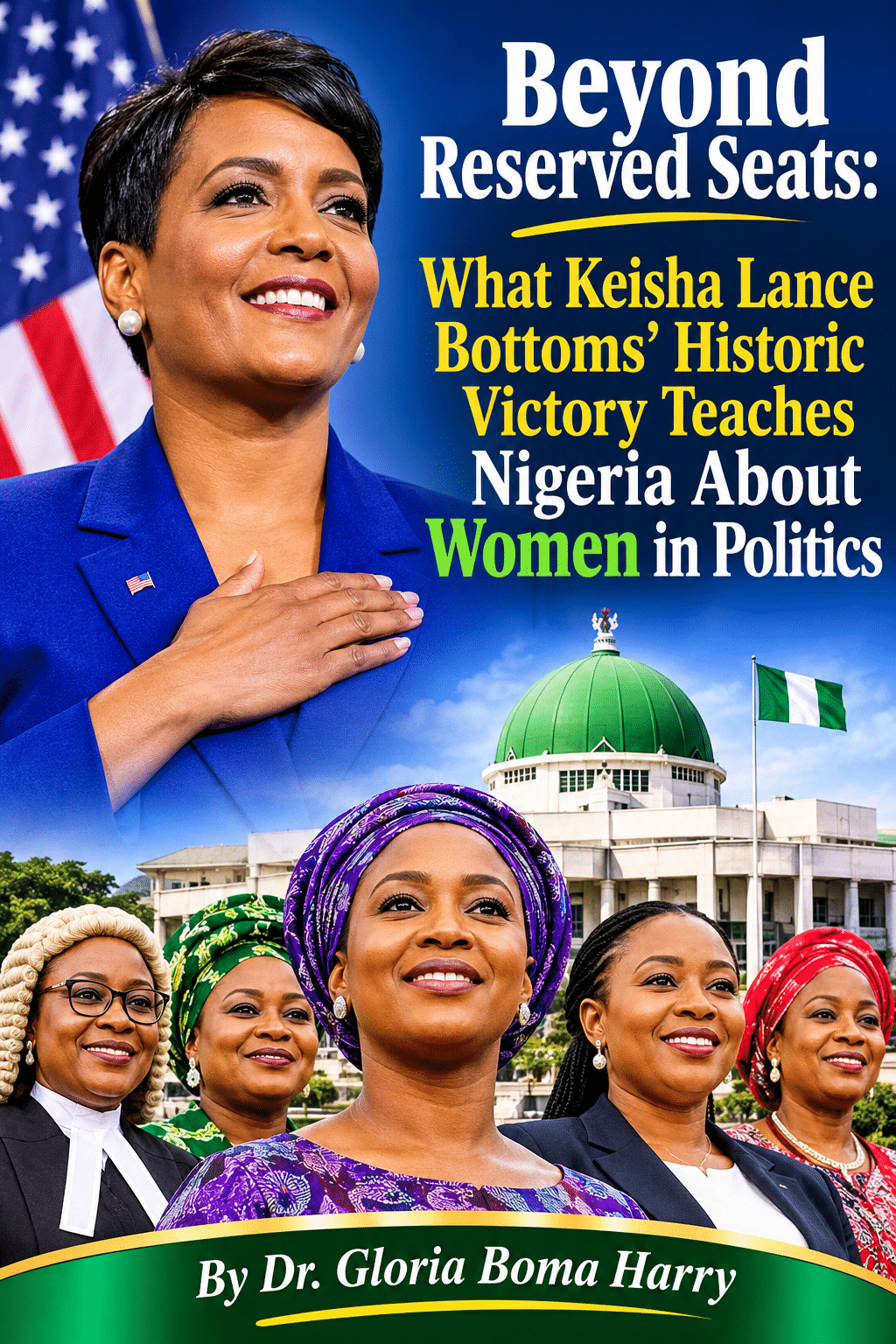

By Dr. Gloria Boma Harry
The election of Keisha Lance Bottoms as Georgia’s first female governor and the first Black woman to govern a US state is more than a remarkable personal achievement. It is a defining moment in the continuing global conversation about women’s political participation, equal opportunity and the structures of power that determine who gets to govern.
Bottoms’ victory in the November 3, 2026 gubernatorial election is particularly significant because it demonstrates that women can rise beyond traditional political boundaries to occupy the highest levels of executive authority. A former Mayor of Atlanta and senior adviser to former US President Joe Biden, she has now entered American political history by breaking a barrier that had endured for generations.
Her achievement offers Nigeria an important moment for reflection, particularly as the National Assembly considers a constitutional amendment proposing additional legislative seats reserved for women.
Under the proposal announced by Senate Leader Opeyemi Bamidele, 37 additional seats would be created in the Senate and another 37 in the House of Representatives, with each state and the Federal Capital Territory having one additional representative in both chambers. Three additional seats are also proposed for each State House of Assembly. The arrangement is expected to operate for 16 years, covering four electoral cycles, before a comprehensive review.
The proposal is an acknowledgement that Nigeria’s political system has not provided women with equitable access to legislative representation. However, the more important question is whether creating additional seats will, on its own, address the deeper structural problems responsible for women’s political marginalisation.
THE GLOBAL CONTRADICTION: WOMEN VOTE, BUT MEN STILL DOMINATE POWER
Across the world, women constitute a substantial proportion of the electorate and contribute significantly to political mobilisation, party organisation, public policy advocacy and national development. Yet their presence in the institutions where binding political and economic decisions are made remains disproportionately low.
According to the 2026 data published by the Inter-Parliamentary Union and UN Women, women occupy approximately 27.5 per cent of parliamentary seats worldwide, while only 28 countries have a woman serving as head of state or government.
These figures expose a fundamental contradiction in modern democracy: political systems frequently depend on women’s participation to secure electoral victories but do not adequately translate that participation into access to political authority.
Nigeria’s situation deserves particular scrutiny. Women have consistently contributed to political parties, election campaigns, community mobilisation and civic engagement. They have also occupied important positions in public administration, academia, business, the professions and civil society.
Yet their representation in elective political offices remains significantly limited.
The problem is not necessarily an absence of qualified women. Rather, it is a political environment in which access to party structures, campaign financing, influential networks and electoral opportunities is often determined by longstanding arrangements that disproportionately favour men.
RESERVED SEATS: A CORRECTIVE MEASURE, NOT A SUBSTITUTE FOR EQUAL OPPORTUNITY
The proposed special seats for women deserve serious consideration as an affirmative-action intervention.
There is an important distinction between creating opportunities for women and weakening the democratic principle of electoral competition. Reserved seats, when properly designed, are not necessarily an attempt to exclude men. They are intended to correct structural disadvantages that prevent a significant section of the population from enjoying equal access to political representation.
International experience provides useful lessons.
Rwanda, for instance, has constitutional provisions guaranteeing women at least 30 per cent of decision-making positions. Its parliament has consistently recorded one of the world’s highest proportions of female representation.
Mexico has pursued constitutional and legislative gender-parity measures, requiring equal representation of women and men in elected positions. Bolivia and several other Latin American countries have similarly employed gender quotas and parity provisions to improve women’s participation in legislative institutions.
These experiences demonstrate that deliberate legal interventions can change the composition of political institutions.
However, Nigeria must understand that the success of such measures depends on more than the number of seats created. The quality of representation, the independence of elected women, their influence over legislation and their access to leadership positions are equally important.
A woman who occupies a legislative seat but remains politically dependent on powerful male sponsors may have limited freedom to represent her constituents or pursue independent policy positions.
The objective, therefore, should not merely be to put more women in parliament. It should be to create an environment in which women can exercise meaningful political authority.
THE LESSON FROM RWANDA, MEXICO AND OTHER DEMOCRACIES
One of the most important lessons from countries that have made measurable progress in women’s political representation is the need for comprehensive electoral reforms.
Rwanda’s constitutional quota framework, Mexico’s gender-parity legislation and the quota systems adopted in several other countries demonstrate different approaches to correcting political imbalances.
The Inter-Parliamentary Union has also emphasised the importance of combining gender quotas with institutional reforms, equal access to leadership positions, enforcement mechanisms and measures to protect women from political harassment and violence.
Nigeria should examine these models critically rather than simply transplanting their provisions.
For example, gender quotas in proportional representation systems often operate through party lists, requiring parties to present women and men in specified proportions. In Nigeria’s predominantly constituency-based electoral system, additional reserved constituencies may offer a more direct route to representation.
However, the design must be transparent. Constituency boundaries, eligibility requirements, nomination procedures, electoral administration and the relationship between reserved and existing seats must be clearly defined.
The proposed 16-year duration also deserves careful attention. A sunset clause can provide an opportunity to evaluate progress, but the review must be based on measurable outcomes rather than political convenience. If structural inequalities persist after four electoral cycles, an automatic withdrawal of the intervention may undermine the very objective it was designed to achieve.
THE ECONOMICS OF POLITICAL PARTICIPATION
Perhaps one of the most neglected obstacles confronting women in Nigerian politics is the financial cost of seeking elective office.
Elections in Nigeria are expensive. Aspirants frequently face substantial nomination fees, campaign expenses, political networking costs and the financial demands associated with party primaries.
For many women, these barriers are compounded by unequal access to business networks, political financiers and established patronage structures.
A constitutional provision reserving seats for women will have limited impact if the political parties that control candidate selection simply transfer existing barriers into the new electoral arrangement.
Nigeria must therefore consider complementary reforms, including transparent and affordable nomination fees, campaign finance support, enforceable party-level gender inclusion policies and stronger financial accountability in political campaigns.
Political parties should also be encouraged to establish credible leadership development programmes, mentorship structures and transparent procedures for identifying and supporting female aspirants.
Women should not have to depend exclusively on influential political godfathers, wealthy relatives or personal benefactors to participate meaningfully in politics.
POLITICAL VIOLENCE, CULTURAL BARRIERS AND THE PRICE OF AMBITION
Another critical issue is the hostility women often encounter when they seek political power.
In many political environments, female aspirants face gender-based insults, character attacks, intimidation, online harassment and, in some cases, physical threats.
Their marital status, appearance, family responsibilities and private lives are frequently subjected to scrutiny in ways that are not always applied equally to male politicians.
Such practices discourage participation and reinforce the perception that politics is an unsuitable environment for women.
Best global practices require more than constitutional guarantees. They demand effective laws against electoral violence, accessible reporting mechanisms, protection for female candidates and consequences for perpetrators of political intimidation.
Political parties must also take responsibility for ensuring that women are not merely included in party membership registers but are protected and respected within their own political structures.
The media has an equally important responsibility to report women’s political activities with the same seriousness, scrutiny and professional standards applied to their male counterparts.
Women in politics should be judged by their policies, public records, leadership decisions and accountability, not by stereotypes or gender-based expectations.
BEYOND NUMBERS: WOMEN MUST ALSO OCCUPY POSITIONS OF INFLUENCE
There is another danger Nigeria must avoid: the assumption that increasing the number of female legislators automatically guarantees gender-sensitive governance.
Representation must translate into influence.
Women should have equitable opportunities to chair important legislative committees, participate in budget decisions, lead parliamentary caucuses and influence policies concerning security, infrastructure, education, healthcare, economic development and national planning.
It would be a mistake to confine female politicians to committees traditionally associated with women and children while men dominate the strategic institutions responsible for national security, finance, petroleum, defence and economic policy.
Women are not a political interest group whose contribution should be restricted to gender-related issues. They are citizens with the same capacity and entitlement to participate in every area of national decision-making.
The experience of countries that have improved women’s representation also shows that political inclusion is more meaningful when women have access to leadership positions and substantive decision-making responsibilities.
THE KEISHA LANCE BOTTOMS MOMENT AND NIGERIA’S DEMOCRATIC TEST
Keisha Lance Bottoms’ victory offers an important lesson that extends beyond America.
Her emergence demonstrates that women can compete for and occupy the highest political offices when electoral participation, political organisation, institutional access and public support create the necessary opportunities.
Her achievement should not, however, be interpreted as evidence that the United States has eliminated gender or racial inequality in politics. One historic victory does not erase the barriers that other women continue to encounter.
Similarly, Nigeria should not measure progress solely by the number of special seats it creates or the number of women appointed to political offices.
The more fundamental test is whether a Nigerian woman can aspire to become president, governor, senator, member of parliament or local government chairman without encountering institutional disadvantages because of her gender.
Can political parties provide women with fair access to tickets? Can female aspirants raise campaign funds without being subjected to exploitative political arrangements? Can women contest elections without intimidation? Can those elected exercise authority without being treated as political proxies?
These are the questions that should define the national conversation.
The National Assembly must also recognise that the proposed constitutional amendment requires a transparent and inclusive legislative process. It must secure the constitutionally prescribed approvals from both chambers and the required number of State Houses of Assembly, followed by presidential assent. Public education and sustained engagement with citizens will be essential to building confidence in the reform.
Governors, political parties, civil society organisations, traditional institutions, professional associations and women’s groups must also recognise that this is not simply a parliamentary issue. It is a question about the character and inclusiveness of Nigeria’s democracy.
THE WAY FORWARD: FROM AFFIRMATIVE ACTION TO POLITICAL PARITY
Nigeria needs a comprehensive national framework for women’s political participation.
First, the proposed reserved seats should be accompanied by enforceable gender-inclusion provisions within political parties.
Second, campaign financing and nomination processes must become more transparent and accessible.
Third, electoral and security institutions must develop effective mechanisms for preventing and responding to violence against women in politics.
Fourth, women must be represented in strategic leadership positions, not merely in numbers.
Fifth, political education, mentorship and leadership development should begin early, particularly at the grassroots, where women often provide the foundation for community political mobilisation.
Finally, the proposed 16-year intervention should be subjected to independent periodic assessment, with clear indicators measuring not only the number of women elected but also their influence, legislative contributions and access to leadership.
The objective should be to create a political culture in which women’s participation becomes normal rather than exceptional.
CONCLUSION: DEMOCRACY CANNOT REACH ITS FULL POTENTIAL BY EXCLUDING HALF OF ITS POPULATION
The historic election of Keisha Lance Bottoms and Nigeria’s proposed special legislative seats may have emerged from different political circumstances, but they converge on one important question: who has the opportunity to participate in shaping the destiny of a nation?
Democracy is not measured exclusively by the frequency of elections or the number of political parties competing for power. It must also be measured by the fairness of access to political institutions and the extent to which different segments of society are represented in decision-making.
Nigeria cannot credibly pursue inclusive development while its political institutions remain inaccessible to a substantial proportion of its population.
Reserved seats may provide an important corrective mechanism, but they must not become an excuse for political parties to abandon the broader responsibility of promoting equal opportunity.
Neither should women be expected to prove their worth through extraordinary personal sacrifices before being considered qualified for political leadership.
The objective is not to replace male dominance with female dominance. It is to build a political system in which competence, integrity, democratic participation and equal opportunity determine access to public office.
Keisha Lance Bottoms has broken a historic barrier in Georgia. Nigeria now faces a different but equally important challenge: whether it can move beyond political promises and translate the principle of women’s inclusion into enduring constitutional, electoral and institutional reforms.
The real measure of progress will not be how many special seats are created, but whether future generations of Nigerian women can enter politics, compete fairly, win elections and exercise power without having to overcome barriers that should never have existed in the first place.
Gloria Boma Harry, PhD writes from Rivers State, Nigeria









Leave a comment