
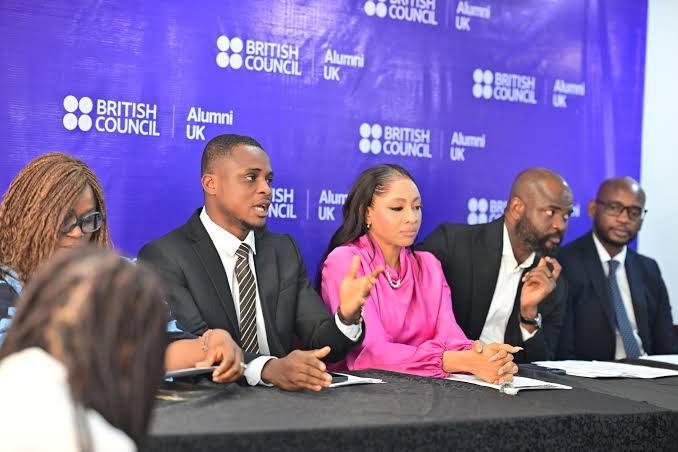

The British Council has awarded grants of up to £5,000 each to seven Nigerians to implement community-based projects addressing climate change, flooding, electronic waste management, girls’ education, unemployment and social inclusion across the country.
The five-month initiatives, which cut across several states, will focus on practical interventions, including training young women to collect flood-related data in Bayelsa State, equipping solar technicians in Rivers State to safely manage discarded solar batteries and improving educational opportunities for disadvantaged girls in Lagos and Imo states.
According to a statement issued by the British Council on Monday, the grants were announced in Lagos on Thursday, November 19, under its 2026–27 Alumni UK Grant Programme.
The awards were presented by the British Council’s Deputy Country Director in Nigeria, Chilufya Besa, who explained that the funding was attached to specific projects, approved budgets and measurable outcomes rather than personal recognition.
“These are not personal awards. The money is tied to a project, an agreed budget and clear results,” Besa said.
He added that beneficiaries would be required to account for their activities, the number of people reached and the lessons learnt during implementation.
“We are not simply recognising seven people for what they have already achieved. We are backing them to do something practical,” he stated.
Four of the selected projects focus on climate action and environmental sustainability, while the remaining three address social inclusion, reducing inequality and empowerment.
In Bayelsa State, May Tamara Stow will implement a project aimed at training 40 young women aged 16 to 24 in Otuoke to collect, analyse and present flood-related data from more than 200 households.
The initiative, to be executed in partnership with the Federal University Otuoke and community leaders, will also produce community flood-preparedness stories and a practical toolkit to help households prepare for flooding.
Similarly, in Rivers State, Peter Abiye Banigo will implement the Solar Second Life Project, which will train 30 informal-sector solar technicians, including women and young people, to repair, restore and safely manage discarded solar equipment and lithium batteries.
The project will also develop open-access training materials and establish a community recovery network in collaboration with a licensed electronic waste recycler.
In Lagos State, Adelopo Abdulganiyu Omobolaji will implement CircuRise, targeting 100 informal waste workers across selected dumpsites and waste-picker communities.
The initiative will equip participants with digital and carbon literacy skills while testing multilingual learning tools, artificial intelligence-assisted waste identification and mobile reporting systems.
In Abuja, Bethel Ikenna Okeke’s Green Cycle Initiative will support 100 adolescent girls and young women aged 15 to 24 in the Durumi and Lugbe internally displaced persons’ camps.
The project will provide menstrual health education, training in reusable sanitary pad production, entrepreneurship and financial literacy, as well as mentorship and business support to help beneficiaries establish small-scale enterprises.
Under the social inclusion and empowerment category, Charity K. Usifoh-Chenge will expand The Next Hundred Public Health Stewards programme to Gombe and Nasarawa states.
The initiative will support between 40 and 50 young people and early-career professionals through training and mentorship, with particular attention to women and underserved groups. Its expansion will be guided by findings from the programme’s 2025 evaluation.
Another beneficiary, David Chukwuma Izuogu, will implement Exam Equity for Girls, a project designed to support 150 girls from low-income families in two underserved secondary schools in Lagos and Imo states.
Led by Africa of Our Dream Education Initiative in partnership with Aspiralane, the project will combine offline-accessible digital learning, artificial intelligence-supported tutoring, mentorship for girls in science, technology, engineering and mathematics (STEM), and scholarship guidance.
Teachers will also receive support to ensure the sustainability of digital learning beyond the project’s implementation period.
The seventh initiative, Bridging Digital Divide for Equal Disability Employment, led by Opeolu Stephen Akinola, will equip 50 undergraduates and graduates with visual, hearing and physical disabilities with digital and employment skills.
Implemented by Accesstech Innovation and Research Centre in partnership with six organisations of persons with disabilities, the project will provide training in digital literacy, assistive technologies, curriculum vitae preparation and interview skills.
To ensure accessibility, training materials will be provided in Braille, large print and screen-reader-compatible formats, while sign language interpretation will also be available.
Speaking on the rationale behind the grants, Besa acknowledged that the funding alone would not resolve the national challenges targeted by the projects but could provide an opportunity for beneficiaries to test their ideas, demonstrate their effectiveness and attract additional support.
“A grant of up to £5,000 will not solve a national problem. It can, however, test an idea,” he said.
He further explained that climate change extended beyond environmental concerns, affecting employment, healthcare, energy, transportation and the ability of communities to withstand economic pressures.
“Climate change is not only about the environment. It affects jobs, health, energy, transport and the ability of communities to cope with economic pressure,” he stated.
On social inclusion, Besa stressed the need to ensure that individuals had equal opportunities to access education, technology, employment and healthcare and participate meaningfully in society.
“Inclusion is about whether people can enter a classroom, use technology, find work, access healthcare and participate properly in society,” he added.
The seven Nigerian projects form part of a broader British Council initiative supporting 61 alumni-led projects across 15 countries. Of the total, 35 focus on climate action and sustainability, while 26 address inclusion, inequality and empowerment.
The British Council explained that applicants in Nigeria were required to be Nigerian nationals residing in the country, have studied at a UK institution for at least one academic term and be independent of political affiliations. The seven beneficiaries were selected through a competitive process.
Highlighting the programme’s contribution to Nigeria-United Kingdom relations, Besa referenced British Council research involving more than 4,000 international alumni of UK institutions.
According to him, the findings showed that nearly three-quarters of the alumni had maintained contact with people they met during their studies in the UK, while more than half of the alumni entrepreneurs surveyed were collaborating or trading with the United Kingdom.
“A UK education, therefore, does not end at graduation,” he said.
The British Council disclosed that it would work closely with the beneficiaries throughout the five-month implementation period, with a global showcase of the projects scheduled for April 2027.
It added that the recipients would be expected to provide transparent accounts of both their achievements and the challenges encountered during implementation.
“Honest evidence is more useful than a success story that leaves out the difficult parts,” Besa noted.
He consequently encouraged organisations, businesses and other stakeholders to support the initiatives through technical expertise, access to communities, equipment, data and other forms of collaboration.
“Not every partnership begins with a large cheque. Sometimes, the right connection is what allows a good idea to move forward,” he said.









Leave a comment