
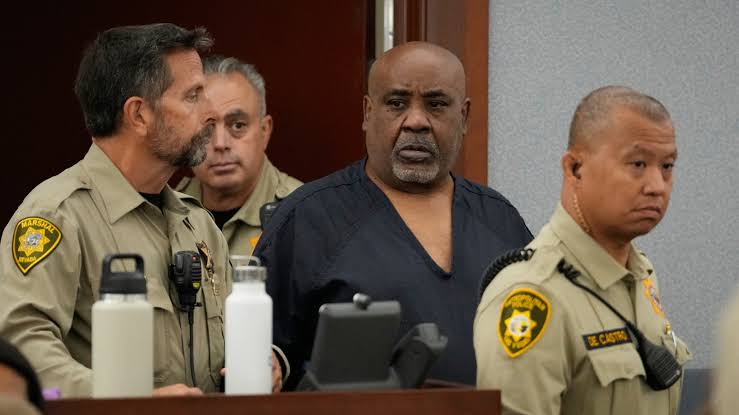

Duane “Keffe D” Davis, a former Los Angeles gang leader convicted over the 1996 killing of American rap icon Tupac Shakur, has been sentenced to a minimum of 40 years in prison, a punishment that could see him spend the rest of his life behind bars.
Davis, 63, was sentenced on Tuesday in a Las Vegas courtroom, nearly three decades after Shakur was shot dead in one of the most notorious unsolved cases in American music history.
The sentence followed years of investigations, public speculation and criticism over the failure to bring anyone to justice for the murder of the influential hip-hop artist, popularly known as 2Pac.
Davis, a former leader of a branch of the Crips street gang, had spoken publicly about his involvement in Shakur’s killing for years. He also claimed in his memoir that he had ordered the attack, but later denied the allegations when he stood trial.
Delivering the sentence, Judge Carli Kierny challenged Davis’s apparent attempts to distance himself from his past.
“For three years, I’ve heard you say some variation of the same thing to law enforcement… in your book,” the judge said, referring to his claims that he had moved on with his life and become a grandfather.
“I’m here to tell you that’s not how this works,” she added.
The judge stressed that Davis could not take another person’s life and simply walk away from the consequences.
“You don’t get to take a man from his family. You don’t get to take his very life, his whole future from him, and just walk away from it. Especially when that man is Tupac Shakur,” she said.
Evidence presented at trial linked the killing to a confrontation at a Las Vegas casino on September 7, 1996, during which members of Shakur’s entourage assaulted Davis’s nephew.
About two hours after the altercation, Shakur was travelling in a BMW driven by Marion “Suge” Knight, co-founder of Death Row Records, when a white Cadillac pulled alongside the vehicle at a traffic light.
A gunman in the Cadillac opened fire, hitting Shakur, who died six days later from his injuries. Knight was also wounded in the attack.
According to the prosecution’s account, Davis handed a firearm to a passenger in the back seat of the Cadillac and instructed the individual to shoot the rapper.
The identity of the person who fired the fatal shots has not been definitively established publicly. Davis was the only surviving occupant of the Cadillac, according to the information presented in the case.
The killing remained one of America’s most closely watched cold cases, fuelling decades of speculation among fans, investigators and the wider music industry.
Shakur was one of the defining figures of 1990s hip-hop, a period marked by a bitter rivalry between artists and record labels associated with the United States’ East Coast and West Coast music scenes.
The rapper, known for songs including California Love and All Eyez on Me, was just 25 when he was killed.
Born to a mother associated with the Black Panther movement, Shakur spent part of his childhood in Harlem, New York, and Baltimore, Maryland, before becoming a central figure in California’s hip-hop scene after signing with Los Angeles-based Death Row Records.
Beyond his music, he was known for lyrics addressing racial inequality, poverty, violence and the experiences of marginalised communities.
His sister, Sekyiwa Shakur, paid an emotional tribute to him during Tuesday’s sentencing proceedings, describing him as someone who “was born an icon”.
She said their mother had deliberately raised him to stand up for vulnerable people and defend those who could not defend themselves.
According to her, Shakur was a source of protection for his family and dedicated his career to advancing the interests of his people.
She also remembered him as a compassionate man who was kind to women and children and provided food for people who could not afford it.
“He was truly my shining star, my shining prince. He was who God trusted to take care of me,” she said.
Davis expressed no remorse before the sentence was handed down, instead maintaining that he would appeal his conviction.
His sentencing marks a significant development in the long-running case that has remained a subject of public fascination since Shakur’s death in 1996.
For nearly 30 years, the murder cast a shadow over the legacy of one of hip-hop’s most influential artists, leaving fans and relatives searching for answers.
With Davis now facing at least four decades in prison, the case has reached a major legal milestone, although questions surrounding the identity of the gunman remain unresolved.











Leave a comment