
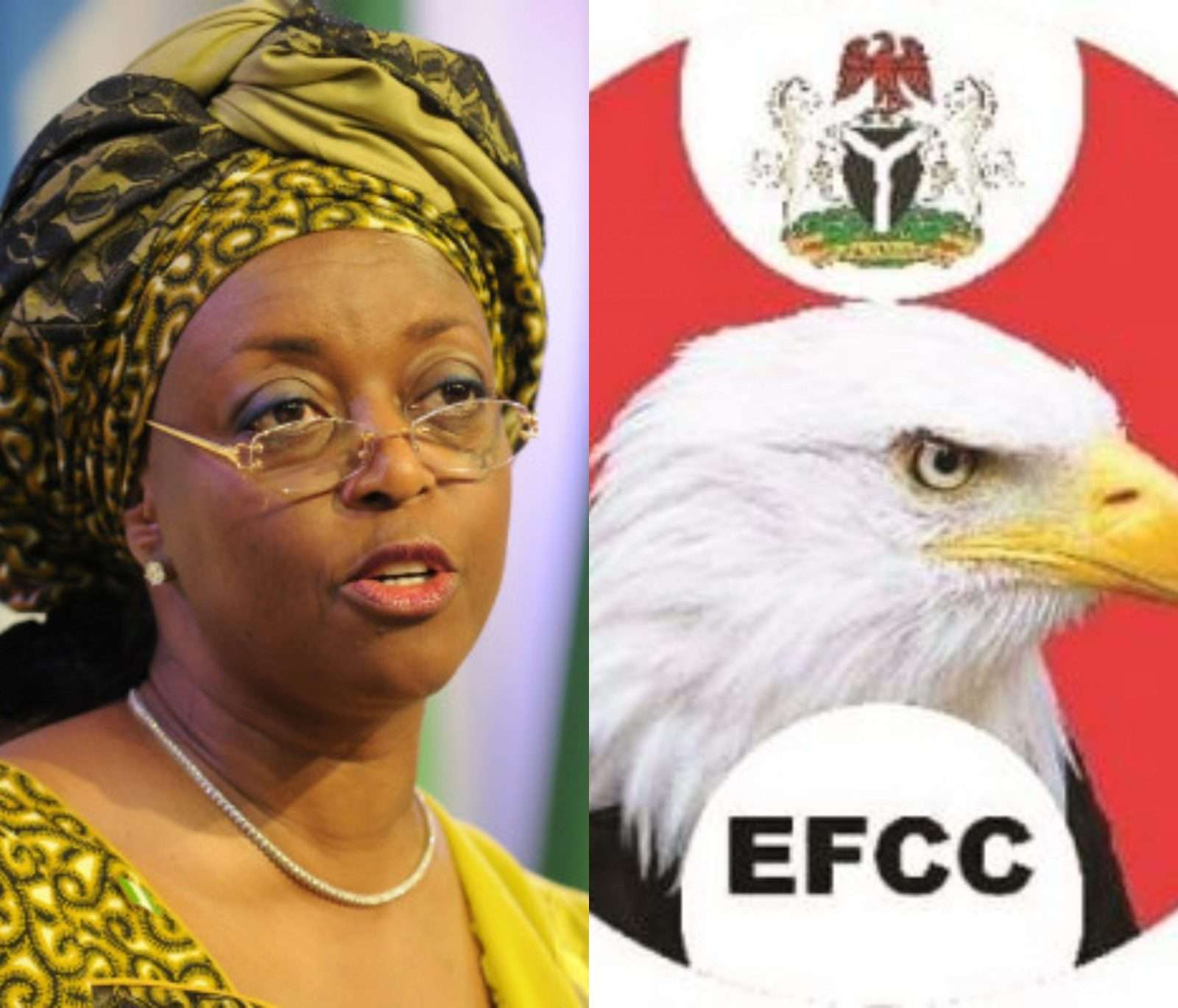

The anti-graft agency argues that the London verdict is irrelevant to the Nigerian case, while the former minister insists it is a material development in her challenge to the forfeiture of assets.
The Economic and Financial Crimes Commission (EFCC) has urged the Federal High Court in Abuja to disregard former Minister of Petroleum Resources Diezani Alison-Madueke’s attempt to rely on her acquittal by a United Kingdom court in her ongoing battle to recover forfeited assets.
In a further counter-affidavit, the commission argued that the June 17, 2026, decision of the Southwark Crown Court in London had no bearing on the substantive issues before the Nigerian court and should not be admitted as evidence in the former minister’s suit.
Diezani is challenging the forfeiture and proposed sale of assets she claims affect her proprietary rights. She maintains that the process raises fundamental questions about fair hearing, due process and compliance with the legal requirements governing the seizure and disposal of property.
The latest dispute arose after Justice Inyang Ekwo granted her permission to file additional evidence concerning the UK proceedings. Her lawyer, Godwin Iyinbor, had sought leave to introduce the development into the case after the British court discharged and acquitted her of criminal allegations of bribery.
The EFCC has since filed a counter-affidavit opposing the move, insisting that the foreign court proceedings are separate from the Nigerian asset-forfeiture case.
In the five-page response, Oyakhilome Ekienabor, a litigation officer in the law firm of EFCC counsel Mofesomo Oyetibo, SAN, described some of the depositions in Diezani’s application as misleading, immaterial and irrelevant.
“The proceedings before the Southwark Crown Court, London, United Kingdom, and the purported acquittal of the applicant therein, are in respect of a proceeding that is not being prosecuted before any Nigerian court and have nothing to do with the substantive suit before this honourable court,” Ekienabor stated.
The commission also disputed the suggestion that the properties listed in the public sale notice necessarily belonged to the former minister.
According to the EFCC, the forfeiture order cited in the proceedings relates exclusively to jewellery and does not cover other categories of assets or properties.
“The order for forfeiture relates exclusively to items of jewelry and does not extend to any other category of assets or properties,” Ekienabor submitted.
The agency further argued that parties should not be permitted to expand the scope of an existing case through supplementary filings. It contended that Diezani’s additional affidavit introduced matters capable of diverting the court from the substantive issues requiring determination.
The EFCC consequently asked Justice Ekwo to discountenance the affidavit insofar as it seeks to introduce evidence of the UK acquittal.
The former minister, however, maintains that her acquittal is a significant development that the Federal High Court should consider in determining her challenge to the forfeiture proceedings.
In a 10-ground application, her lead counsel, Prof. Mike Ozekhome, SAN, argued that the suit challenges, among other things, the EFCC’s public notice concerning the auction or sale of properties and personal effects allegedly affecting his client’s proprietary rights.
Ozekhome contended that the commission sought to impose serious consequences on Diezani’s property rights without a conviction, a fair hearing or strict compliance with the statutory provisions governing forfeiture, management and disposal of assets.
He explained that Diezani filed her amended originating motion on February 19, 2025, after obtaining the court’s leave on February 17, 2025.
According to the lawyer, the UK court’s decision on June 17, 2026, occurred after the earlier processes had been filed and therefore constituted a subsequent development that could not have been included in the original filings.
“The said subsequent development is material and relevant to the applicant’s case, particularly as it relates to the issues of absence of conviction, fair hearing, due process, propriety of irreversible proprietary deprivation, and the need for strict compliance with statutory safeguards before disposal of properties affecting the applicant’s proprietary rights,” Ozekhome argued.
He emphasised that Diezani was not asking the Nigerian court to sit on appeal over the UK judgment or automatically treat the foreign decision as conclusive in the Nigerian proceedings.
Rather, he said, the application was intended to place a new and material fact before the court to assist it in reaching a just determination of the dispute.
Ozekhome further argued that the court had the discretion to admit additional evidence where doing so would assist in resolving the issues before it. He maintained that allowing the filing would not prejudice the EFCC.
At Tuesday’s proceedings, Diezani’s lawyer, Queen-Ubokutom Uwe, informed the court that the matter had been scheduled for the hearing of the EFCC’s preliminary objection and the originating motion.
She, however, told the judge that the commission had served her team with a further counter-affidavit shortly before the hearing.
EFCC counsel, Paul Mgbeoma, expressed surprise at the number of processes being filed by Diezani’s legal team but said he was ready to proceed with the hearing.
Justice Ekwo subsequently adjourned the matter until November 11, 2026, for the hearing of the pending motions.
The suit, marked FHC/ABJ/CS/21/2023, names the EFCC as the sole respondent.
The central question now is whether the former minister’s acquittal in the UK can be admitted as additional evidence in her Nigerian case and, if admitted, what bearing it may have on the issues before the court.
While Diezani argues that the decision is relevant to her claims concerning fair hearing, due process and the protection of property rights, the EFCC maintains that the British proceedings are separate from the Nigerian forfeiture dispute.
The Federal High Court is yet to determine the competing arguments over the admissibility and relevance of the additional evidence. Its decision on the pending applications is expected to clarify the scope of the proceedings as the legal battle over the assets continues.












Leave a comment