
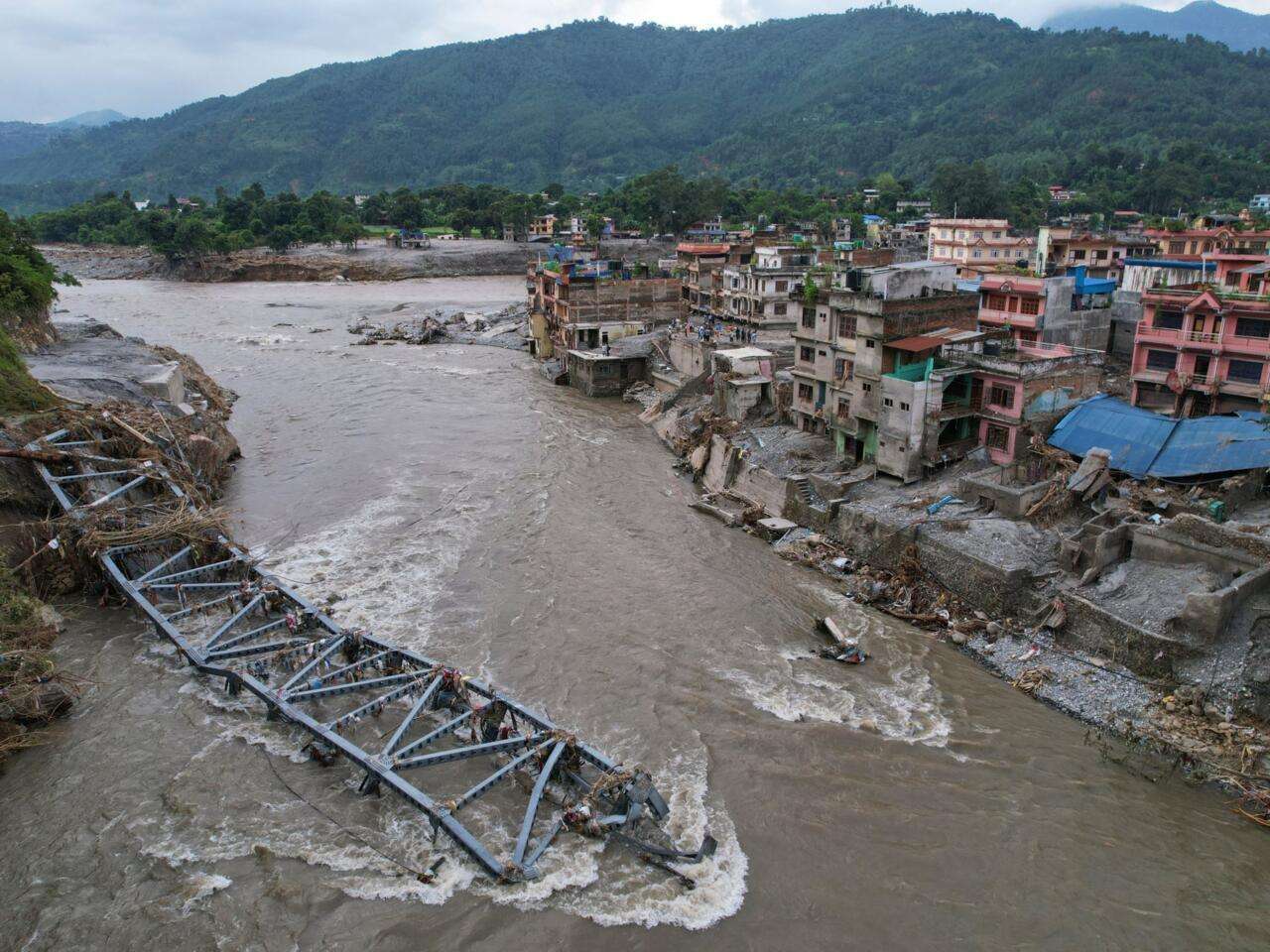

Anxiety and grief have gripped communities across Nepal as families gathered at hospitals, relief centres and military bases seeking information about relatives still missing following catastrophic flash floods that have claimed at least 750 lives.
The country’s disaster management authorities said 2,426 people remained unaccounted for in Nepal, while more than 550 others were reported missing in neighbouring Tibet. Among those missing are 33 British nationals, including a 13-year-old girl.
The scale of the disaster has overwhelmed local authorities, with rescuers racing against time to locate survivors and identify recovered bodies amid warnings of further flooding.
Nepal’s Foreign Minister, Shisir Khanal, said the affected region remained on “high alert”, warning that parts of the landscape had been transformed into “swampland” following the devastating floods.
Rescue operations were continuing at a hydropower construction site where more than 100 workers are believed to be trapped inside a mud-filled tunnel. Nepali army rescuers have pumped air into the tunnel and deployed cameras in an effort to establish contact with those trapped underground.
The disaster agency has also reported that at least 933 hydropower workers remain missing.
Khanal appealed to the international community for specialist assistance, particularly in rescuing people trapped in flooded tunnels, DNA testing and the preservation and storage of recovered bodies.
Authorities Struggle to Identify Victims
The enormous number of fatalities has created severe challenges for authorities responsible for recovering and identifying victims.
The District Administration Office in Chitwan said it had recovered 233 bodies but had been able to identify only four. Some remains have reportedly been carried hundreds of kilometres downstream into neighbouring India.
Makeshift morgues have been established in community halls and police facilities across affected areas, but the shortage of refrigeration has raised concerns about the rapid decomposition of bodies in the prevailing heat and humidity.
“If the current storage conditions persist, we will face a severe public health crisis within 48 hours,” said Subas Sunar, a volunteer at a facility storing bodies in Bharatpur, Chitwan.
In Kathmandu, grieving relatives gathered outside Tribhuvan University hospital, posting photographs of missing family members in the hope of receiving information about their whereabouts.
Families were also seen at an army base in Nuwakot, where helicopters carrying out rescue operations landed. Military personnel displayed lists containing the names of people reported missing, with relatives crowding around the notices, photographing the names and searching anxiously for information.
Britain Deploys Crisis Response Team
The United Kingdom has deployed a rapid response team to Nepal to assist British nationals affected by the disaster.
The team, comprising specially trained crisis response personnel, arrived in the country on Saturday and will work alongside the British Embassy and Nepalese authorities.
Among the missing British nationals are relatives of Essex-based nurse Rajendra Pudasaini, president of the Non-Resident Nepali Association UK, who said members of his family had been “swept away” by the floods.
Pudasaini has launched a fundraising campaign to support victims of the disaster, describing the situation in Nepal as an “irreplaceable loss”.
Another British woman, Tulshi Patel, said her mother, Hemangini Jitendra Patel, and her aunt, Hema Sunil Amin, had travelled to the region on pilgrimage and planned to visit Tibet.
Patel said her family had located footage on TikTok showing the two women and other members of their tour group at a border crossing shortly before the floods.
She said the family continued to call and send messages to the missing women but remained uncertain about their fate.
Nepal Seeks Technical Support
Although Nepal has declined international offers to deploy search-and-rescue teams, the government has said it needs technical expertise and assistance with recovery and reconstruction.
Finance Minister Swarnim Wagle told Reuters that rebuilding the devastated areas could cost between $4 billion and $5 billion.
More than 6,600 people have been rescued, according to Nepal’s National Disaster Risk Reduction and Management Authority, as emergency teams continue to search for survivors.
The Red Cross said at least 93,000 people had been affected by the crisis.
Disaster Renews Climate Change Concerns
The catastrophe has also intensified concerns about the impact of climate change on the Himalayan region.
The floods were triggered after part of a glacier and the mountainside beneath it collapsed on Langtang Lirung, a mountain straddling the Nepal-Tibet border. The collapse sent huge quantities of ice, rock and mud into a river, triggering devastating flooding downstream.
Experts have warned that temperatures in the affected Himalayan region have been rising at roughly five times the global average since the 1960s, while the rate of ice loss has doubled since 2000.
Khanal called on the international community to recognise the vulnerability of Nepal and the wider Himalayan ecosystem to climate change.
“We’d ask the world… to take climate change as one of the major challenges that Nepal and its citizens face, and this has to be a global effort,” he said.
“We request the global community to come together and preserve the Himalayan ecosystem.”
With thousands still missing, hundreds of bodies awaiting identification and large-scale reconstruction ahead, Nepal faces a prolonged humanitarian and recovery crisis following one of the region’s most devastating recent natural disasters.











Leave a comment