
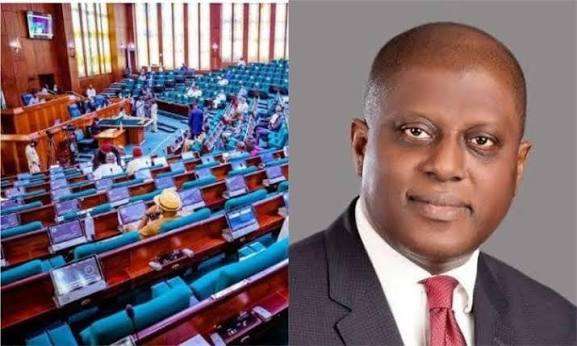

The House of Representatives Public Accounts Committee has intensified its investigation into the remittance of operating surpluses by federal agencies, directing the Office of the Accountant-General of the Federation (OAGF) to provide a comprehensive account of outstanding revenues allegedly owed to the Federal Government by the Central Bank of Nigeria (CBN), the Nigerian National Petroleum Company Limited (NNPCL) and other government-owned enterprises.
The committee also demanded detailed explanations over allegations that the OAGF withdrew billions of naira from the statutory accounts of several Ministries, Departments and Agencies (MDAs), including the reported deduction of ₦15 billion from the Universal Basic Education Commission (UBEC), amid concerns that such withdrawals may have impaired the agencies’ ability to perform their statutory responsibilities.
The directives were issued during an investigative hearing at the National Assembly on Tuesday, where the Accountant-General of the Federation, Mr Shamseldeen Ogunjimi, appeared alongside senior Treasury officials.
The investigation forms part of the committee’s oversight of public finances and compliance with the Fiscal Responsibility Act, which requires government-owned enterprises to remit a prescribed percentage of their operating surplus into the Consolidated Revenue Fund.
The operating surplus framework was established to boost government revenue and reduce financial leakages. However, compliance has remained a longstanding concern, with several agencies repeatedly accused of under-remitting or failing to remit their statutory obligations.
Opening deliberations, a member of the committee, Mr Gboyega Isiaka, expressed concern over Nigeria’s low revenue performance, arguing that inadequate remittance by government agencies continued to weaken the country’s fiscal position.
“Considering our GDP, ours is one of the lowest on the continent, at about 16 per cent. Business entities are expected to return about 80 per cent of their operating surplus, while others remit between 20 and 50 per cent,” Isiaka said.
He questioned the transparency of the operating surplus declared by major agencies, including the CBN, Securities and Exchange Commission (SEC) and the Nigerian Maritime Administration and Safety Agency (NIMASA), stressing the need to compare declared surpluses with the scale of assets under their management.
Responding on behalf of the OAGF, the Director of Revenue and Investment, Mr Makinde Mogaji, disclosed that the Central Bank of Nigeria allegedly owes the Federal Government ₦5.3 trillion in unremitted operating surplus.
According to him, previous efforts by the Public Accounts Committee to recover the funds had yielded no success.
“Early last year, the CBN was owing the Federal Government ₦5.3 trillion as operating surplus. Despite the efforts of the Public Accounts Committee to recover the money, it has not been paid.
“Seventy per cent of that amount ought to have been remitted, but the CBN refused to pay. That is just one of our major sources of revenue. In contrast, an agency like FAAN has remitted ₦473 billion,” Mogaji said.
The hearing also focused on the OAGF’s policy of automatically deducting anticipated operating surplus from the accounts of MDAs before the end of each financial year.
Defending the policy, Accountant-General Ogunjimi said it had significantly enhanced government revenue generation.
“That was an ingenious way of taking, in advance, what was due to the government, and it helped us generate substantial revenue last year,” he said.
He acknowledged, however, that the initiative encountered resistance from several agencies, resulting in reviews and reversals in some instances.
“When we introduced the initiative and generated significant revenue, some agencies sought reversals. Some went to the President, arguing that the deductions were excessive. In some cases, the deductions were cancelled entirely; in others, they were reduced,” Ogunjimi explained.
He also disclosed that disagreements with the Nigerian National Petroleum Company Limited affected implementation of the policy.
“There were instances where agencies such as the NNPCL refused to cooperate to the extent that they had to be asked to leave because of their non-compliance. While NNPCL accepted some of the liabilities, it disputed others, and those issues are still being considered by a post-mortem committee,” he added.
Providing further clarification, Mogaji stated that the auto-deduction system remained operational and was designed to reconcile agencies’ actual operating surplus after their annual accounts had been finalised.
Despite the explanations, members of the committee questioned both the legality and implications of withdrawing funds from agencies established to deliver critical public services.
Committee Chairman, Mr Bamidele Salam, cited petitions received from UBEC, the National Agency for Science and Engineering Infrastructure (NASENI) and other agencies alleging that statutory allocations had been withdrawn without timely reimbursement.
“UBEC claimed that funds approved under its November 2025 Authority to Incur Expenditure were not released by the Accountant-General. It also alleged that ₦16 billion and another ₦15 billion were taken from the commission’s account without refund.
“We are concerned about these deductions from statutory allocations to critical government institutions. It is not only UBEC. NASENI raised similar complaints involving over ₦70 billion, and several other agencies have also made similar allegations. So, what is the justification?” Salam asked.
In response, Ogunjimi maintained that the withdrawals were temporary and undertaken only to meet urgent government financial obligations, describing them as short-term loans that were subsequently refunded.
“There have been occasions when the government needed to meet critical financial obligations, and we temporarily utilised funds belonging to some agencies. It is essentially a loan, and we have been refunding those agencies,” he said.
He explained that such actions were taken only after determining that the funds had remained idle for extended periods and upon directives from the Minister of Finance.
Citing an example, the Accountant-General disclosed that over ₦300 billion belonging to the Tertiary Education Trust Fund (TETFund) had previously been utilised and fully refunded.
However, Salam rejected the justification, insisting that agencies entrusted with delivering essential public services should not be deprived of funds appropriated by law.
“Which agencies have actually been refunded? UBEC is complaining, NASENI is complaining, NBC is complaining, and several others currently under investigation have made similar claims.
“UBEC is expected to build schools, provide infrastructure and supply instructional materials. It cannot effectively discharge those responsibilities if its statutory funds are diverted to other purposes,” he said, adding that Nigeria’s estimated 13.5 million out-of-school children underscored the importance of safeguarding education funding.
The committee subsequently directed the Office of the Accountant-General to submit detailed documentation outlining outstanding operating surplus owed by the CBN, NNPCL and other government-owned enterprises, as well as comprehensive records of deductions from MDA accounts, refunds already made and outstanding balances.
Lawmakers said the investigation would continue in the coming weeks as the committee seeks to establish the level of compliance with the Fiscal Responsibility Act, recover outstanding revenues due to the Federal Government and determine whether the deductions from statutory agency accounts were carried out in accordance with the law.






Leave a comment