

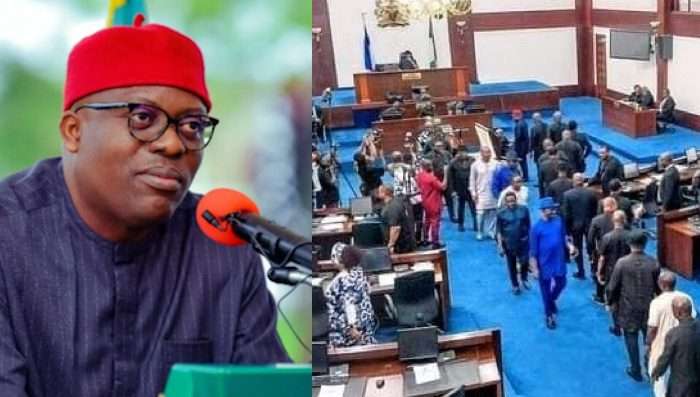

The political volatility in Rivers State has escalated further as four members of the House of Assembly formally withdrew their previous mediation efforts, reaffirming their commitment to the impeachment proceedings against Governor Siminalayi Fubara and his Deputy, Professor Ngozi Odu.
At a press conference held in Port Harcourt on Friday, the lawmakers expressed profound disappointment, citing a lack of remorse from the executive duo regarding allegations of gross misconduct. The group, which had previously advocated for a political resolution to the impasse, claimed their overtures were met with hostility rather than diplomacy.
The Minority Leader, Sylvanus Nwankwo, representing Omuma Constituency, led the briefing by recalling a previous appeal made on 12 January alongside his colleague, Peter Abbey. He noted that while they had sought a “political solution” to bridge the chasm between the Assembly and the Government House, the Governor allegedly chose a path of confrontation.
“During the pendency of this appeal, we discovered that the Governor and the Deputy have deployed media aides to continuously assault the dignity of the Rivers State House of Assembly,” Mr Nwankwo stated. “It is on this basis that we are saying the impeachment proceedings should continue. We have rescinded our plea.”
Corroborating these claims, Peter Abbey dismissed attempts to frame the crisis as a tribal conflict. “I am an Ijaw man like the Governor; we should not ethnicise this. It is strictly a constitutional matter,” he remarked, asserting that the executive branch had continued to violate statutory provisions.
The Deputy Minority Leader, Barile Nwakoh (Khana Constituency I), further alleged that the administration’s strategy had shifted toward the intimidation of the legislature. While she commended President Bola Tinubu for his earlier intervention, she lamented that the Governor and Deputy appeared “adamant” in their refusal to govern within the bounds of the law.
“Their strategy is to intimidate us into withdrawing the impeachment process for a third time while they continue their infractions,” she added.
Emilia Lucky-Amadi, representing Obio/Akpor II, echoed these sentiments, suggesting that the Governor had treated the lawmakers’ concerns with disregard, allegedly boasting that the Assembly lacked the authority to perform its oversight functions.
The session culminated in a decisive legislative move, as the House voted in favour of the Chief Judge of the State inaugurating a formal probe panel to investigate the Governor and Deputy Governor.
The Assembly originally initiated the impeachment process on the grounds of “gross misconduct.” With this latest development, the prospect of a reconciled executive and legislature appears increasingly remote, as the state moves closer to a formal judicial inquiry into its top two officials.




Leave a comment