

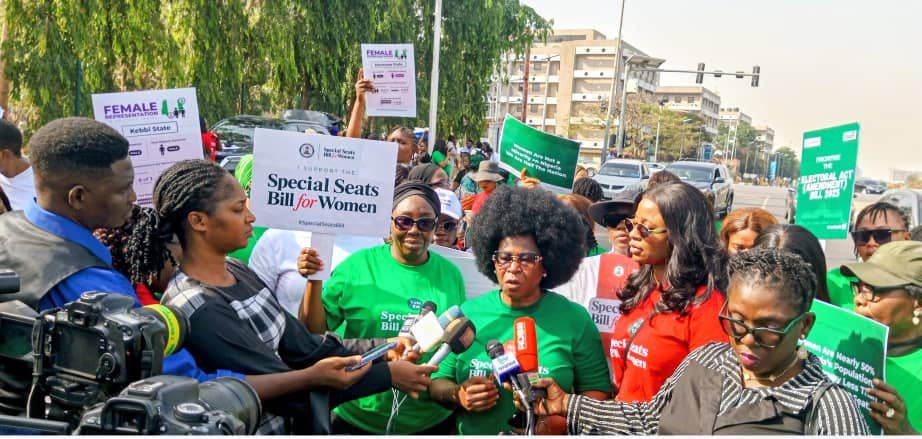

A coalition of prominent women’s advocacy groups staged a peaceful rally at the main entrance of the National Assembly on Tuesday, demanding the immediate passage of the Women Reserved Seats Bill.
The proposed legislation, which is among 44 prioritised constitutional-altering bills awaiting a final vote, seeks to amend the 1999 Constitution of the Federal Republic of Nigeria to provide dedicated legislative seats for women at both federal and state levels.
The bill is designed as a temporary measure to address the chronic gender imbalance in Nigeria’s legislative houses. By creating special constituencies to be contested and filled exclusively by women, advocates argue the nation can finally move toward more inclusive governance.
Speaking at the rally, Ene Obi, former Convener of the Nigeria Civil Society Situation Room, lauded the progress made by lawmakers thus far but urged for expedited action. She emphasised that the passage of the bill is crucial to ensuring women have the opportunity to contest these specific seats in the 2027 general election.
“A vote for a woman is a vote for life,” Ms Obi stated. “We are not protesting today; we are holding a rally. We believe in non-violence and have organised ourselves accordingly. We are calling on the members of the National Assembly to come here and address us.”
The representative of the International Federation of Women Lawyers (FIDA), Rahila Dauda, described the current level of female representation in Nigeria as a national embarrassment. This sentiment is underscored by the stark reality of the current political landscape across the federation.
Analysis of the current gender distribution reveals a troubling trend of exclusion in sub-national governance. Across the 36 State Houses of Assembly, women remain significantly marginalised:
Total Exclusion: In approximately 15 states, there are currently no women serving in the House of Assembly.
Minimal Presence: In states that do have female representation, most averages fall between one to three women out of 24 or 32 members.
Regional Disparity: While some southern states have recorded a slight increase in female legislators, several northern states continue to see zero female participation in their respective assemblies.
The rally also highlighted the specific needs of women living with disabilities. Advocate Lois Auta called for a mandatory 5% reservation of the proposed special seats for women and girls with disabilities, in accordance with the provisions of the Disability Act.
“We are here to ask for our rights: rights for inclusion, representation, and participation in governance,” Ms Auta declared. “In the Disability Act, 5% is enshrined for persons with disabilities. It is time we move from exclusion to inclusion. We are saying: include us now!”
The National Assembly is currently under significant pressure to conclude the constitutional review process. As the 2027 election cycle approaches, the “Reserved Seats Bill” has become a litmus test for the government’s commitment to gender equity.
Advocates maintain that without these “special seats,” the pattern of zero-female representation in many State Houses of Assembly is likely to persist for another four-year cycle.











Leave a comment