
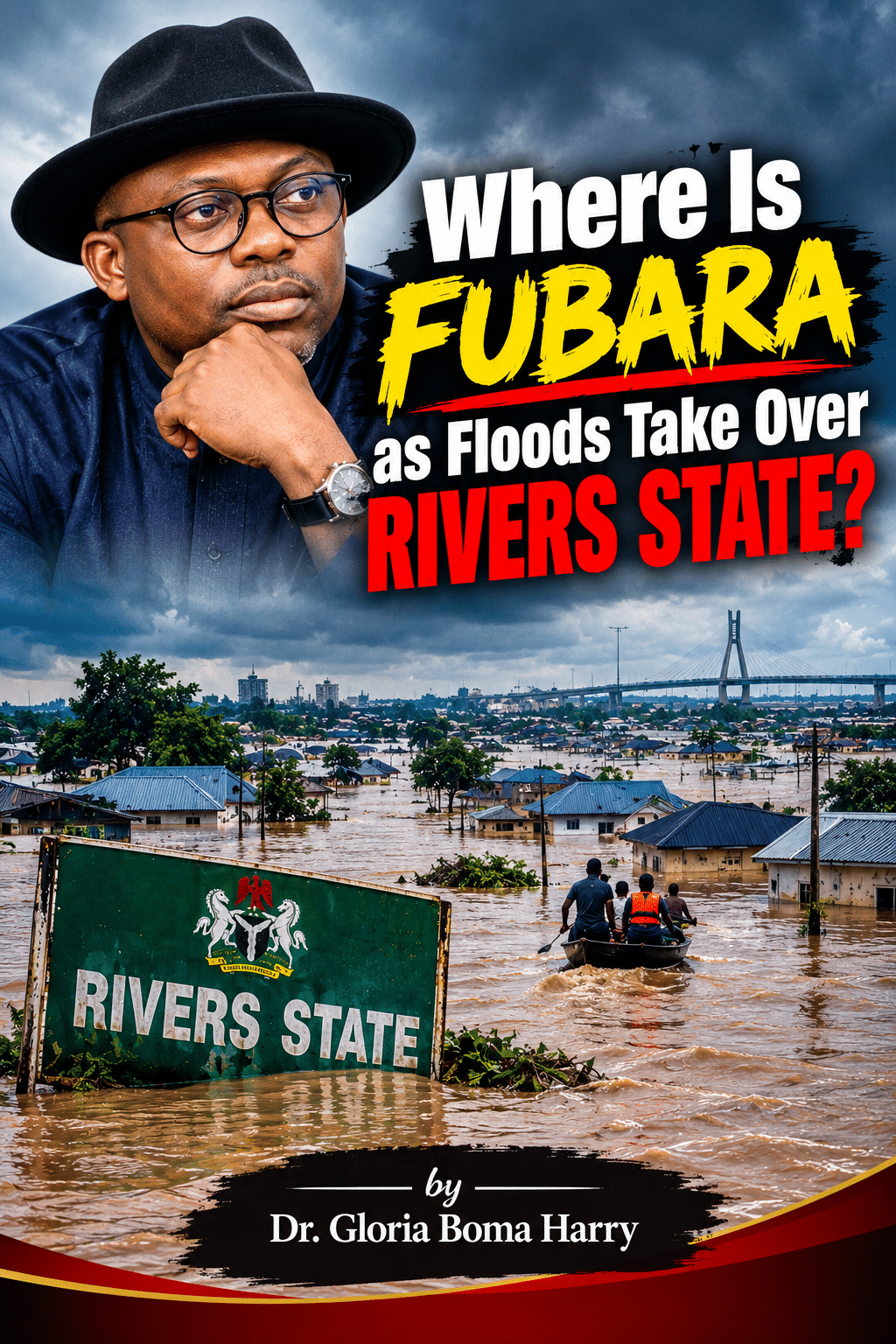

By Dr. Gloria Boma Harry
Where is Governor Siminalayi Fubara as floods take over Rivers State? That is the question many residents are asking as large parts of Port Harcourt and its environs disappear beneath floodwater.
From NTA Road and Peter Odili Road to Rukpokwu, Ozuoba, Ogbogoro-Rumukwachi, Eneka, parts of Iwofe and Mile 4, roads and homes have been submerged, businesses disrupted and families displaced. This is more than a story about rain.
It is a story about preparedness, town planning and governance.
Rivers State is a rainforest. Heavy rainfall is not unexpected. But the scale of the current flooding should force the government to confront a fundamental question: why is a major coastal city still so vulnerable to predictable seasonal rainfall?
Did Government See This Coming?
In February 2026, the Nigerian Meteorological Agency, NiMet, released its Seasonal Climate Prediction, providing information intended to help governments and other stakeholders prepare for expected weather conditions.
NiMet has also issued flood-risk advisories during the year, including a flash-flood risk alert covering September 21–30. The question, therefore, is not simply whether it rained.
The question is what the government did with the warnings.
For a flood-prone state, weather forecasts should translate into action: drainage maintenance, desilting, protection of waterways, enforcement of building regulations, emergency preparedness and protection of vulnerable communities. A forecast that is not converted into preparedness is merely information.
Where Is the Town Planning?
Who approved buildings in flood-prone areas? Who protects natural waterways and drainage corridors? Who ensures that developers provide adequate drainage? Who enforces approved building plans? Who maintains the drains before the rains arrive? These questions matter because flooding is not caused by rainfall alone.
Research on Port Harcourt’s flood vulnerability has identified poor urban planning, inadequate drainage and land-use practices among factors contributing to the city’s exposure to flooding.
For a state like Rivers, town planning should be the first line of defence, not an emergency response after disaster strikes.
The Wike-Fubara Rift
And then there is the politics. The bitter rift between Governor Fubara and his predecessor and former political benefactor, Nyesom Wike, has dominated Rivers politics since 2023.
Their political confrontation eventually contributed to a broader constitutional crisis that saw the suspension of the state’s elected government during the 2025 state of emergency. But Rivers cannot be governed through political trenches.
Floodwater does not recognise political factions. It does not distinguish between Wike supporters and Fubara supporters. It simply enters homes. Whatever disagreements exist between the two political camps, governance must continue.
Drainage master plans cannot wait for political reconciliation. Urban development cannot be put on hold while political battles consume public attention. And Rivers residents should not become collateral victims of political instability.
Relief Is Not Prevention
The Fubara administration has undertaken relief measures for flood victims. But there is a fundamental difference between responding to a disaster and preventing one. Relief materials may help a displaced family survive.
They cannot replace a drainage system. They cannot rebuild a flooded road. They cannot recover household property destroyed by floodwater. And they cannot substitute for proper urban planning.
Residents, too, have responsibilities. Dumping refuse into drains, building over waterways and ignoring planning regulations can worsen flooding.
But government bears the greater institutional responsibility because it has the authority to regulate development, enforce planning laws, protect waterways and maintain public infrastructure.
Where Is Fubara?
This is where the Governor’s leadership must be tested. Not by political speeches. Not by another round of political accusations. But by whether Rivers State can develop a credible, long-term strategy to protect its people from flooding.
The state needs comprehensive flood-risk mapping, protected waterways, functional drainage networks, strict development control, regular desilting, preservation of wetlands and effective emergency evacuation plans.
It also needs accountability. If buildings have been approved in places where they should not have been built, who approved them? If waterways have been obstructed, who allowed it? If drains have not been maintained, who was responsible? And if warnings were available, why were they not translated into adequate preparedness?
Rivers Deserves Better
The present flooding should be a wake-up call for the Fubara administration. Rivers State cannot continue to treat flooding as an unavoidable act of nature. Rain is natural. Poor planning is not.
The Governor must now demonstrate that the government is not merely capable of responding after disaster strikes, but capable of anticipating risks and preventing avoidable suffering.
The issue is bigger than Wike. It is bigger than Fubara. It is bigger than political parties. But today, one question hangs over Rivers State: Where is Fubara as floods take over the state? The water is rising. The people are watching. And they deserve answers.
Dr. Gloria Boma Harry writes from Port Harcourt, Rivers State (gloriab4real@gmail.com)










Leave a comment