

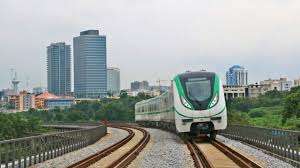

The Nigerian Senate has expressed grave concern regarding the precipitous decline of the nation’s railway infrastructure, with Senate President Godswill Akpabio remarking that the Abuja–Kaduna service has slowed to such an extent that a bicycle or commercial tricycle (Keke Napep) might now outpace it.
The stark assessment was delivered on Thursday during a plenary session, as lawmakers deliberated on the deteriorating performance of the Abuja–Kaduna–Kano corridor. In response to the crisis, the Senate has inaugurated an ad hoc committee, chaired by Senator Adams Oshiomhole, to conduct a comprehensive six-week investigation into the systemic failures of the railway network.
The debate was set in motion by Senator Abdul Ningi (PDP, Bauchi Central), who presented a harrowing account of the service’s collapse. Rising under a personal explanation, Senator Ningi described the current state of the rail line as a “tragic Nigerian story,” contrasting its present inefficiency with its successful launch in 2015.
According to Ningi, the service originally facilitated ten daily trips, five in each direction moving approximately 10,000 passengers every day. Recent statistics, however, paint a somber picture:
Passenger Volume: Daily traffic has plummeted from 10,000 to fewer than 900. Frequency: Operations have been slashed from ten daily shuttles to just two. Revenue: Monthly revenue, once peaking at ₦1.8 billion, is now under severe threat.
The Senate President lamented the erosion of the service’s primary advantage: speed. A journey that once took a mere ninety minutes now frequently exceeds three and a half hours.
“If you are using a bicycle, you will get to Kaduna faster than the train,” Senator Akpabio remarked. “We gather that even a Keke Napep will arrive more swiftly. This is a total collapse in efficiency.”
Beyond mere delays, Senator Ningi raised serious allegations regarding the integrity of the original project execution. He suggested that Nigeria may have been “short-changed,” alleging that some of the equipment installed by the contractors appeared to be second-hand.
The 186.5-kilometre standard gauge line, a $1.64 billion undertaking partially funded by a $500 million loan from China’s Exim Bank, was once heralded as a flagship of Nigerian infrastructure. It was initiated under the Yar’Adua administration, sustained by President Jonathan, and ultimately commissioned in 2016 by the late President Buhari.
The newly formed committee is tasked with identifying the root causes of this decline and recommending urgent remedial measures. Joining Senator Oshiomhole on the panel are several high-profile lawmakers, including:
Senator Enyinnaya Abaribe (Abia South), Senator Adamu Aliero (Kebbi Central), Senator Ireti Kingibe (FCT) and Senator Solomon Adeola (Ogun West)
The committee is expected to submit its findings within six weeks, as the Senate seeks to restore a vital transport artery that many Nigerians now feel has been left to decay.








Leave a comment