

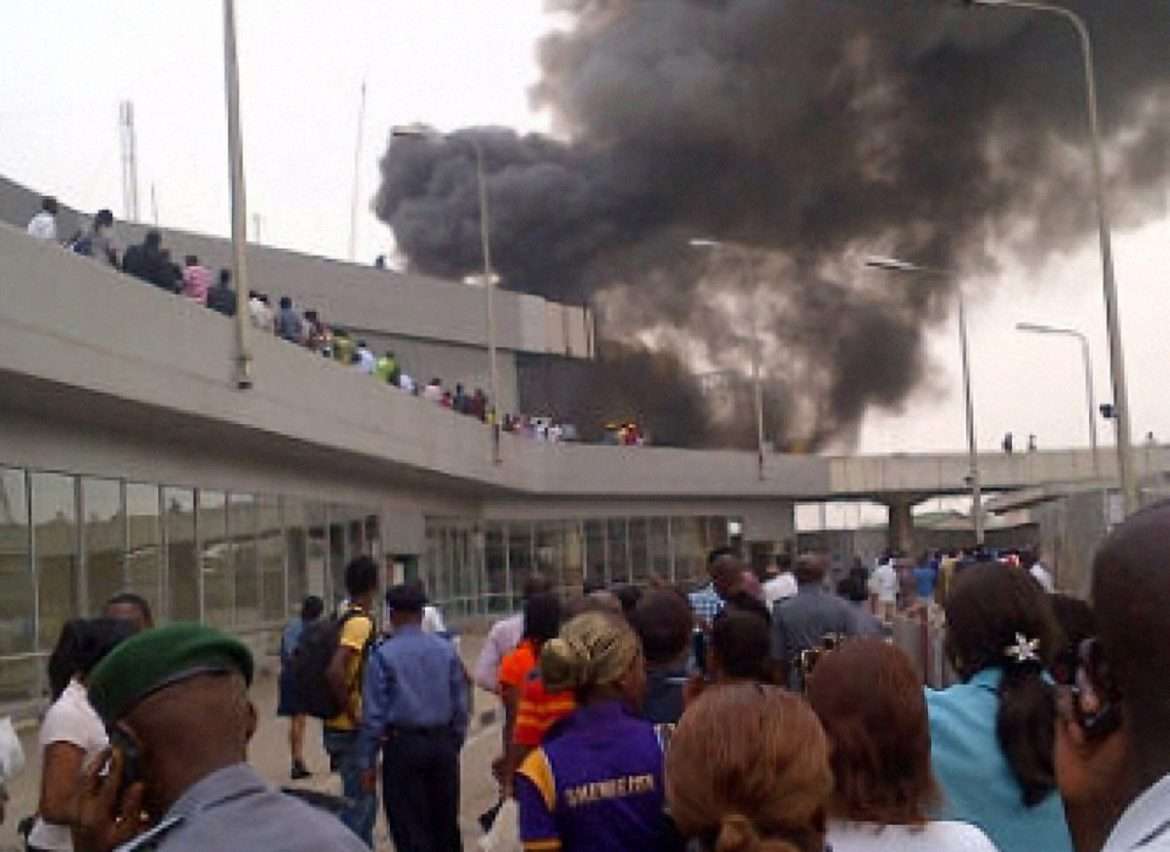

Flight operations at Nigeria’s premier gateway, the Murtala Muhammed International Airport (MMIA), were plunged into chaos on Monday following a severe fire outbreak that razed critical sections of the old terminal for several hours.
The inferno, which reportedly commenced at approximately 2:00 p.m., remained unquenched until 8:00 p.m., forcing the temporary closure of the national airspace and leaving hundreds of international and domestic passengers stranded in a state of operational limbo.
The blaze originated in the server room on the first floor of Terminal 1, according to preliminary findings from the Fire Service. It quickly spread, impacting the control tower and other vital operational areas.
In a high-stakes rescue mission, the Federal Airports Authority of Nigeria (FAAN) deployed a crane to the control tower, successfully evacuating fourteen personnel who had become trapped by the rising smoke and flames. While six casualties three men and three women were recorded, officials confirmed they remain in stable condition, with one individual transferred to the FAAN Headquarters Hospital for further evaluation.
The prolonged disruption triggered a wave of flight cancellations and diversions. Inbound international flights, including those operated by Turkish Airlines and Lufthansa, were reportedly forced to land in Accra, Ghana, while a KLM flight from Amsterdam was diverted to Abuja.
Passengers at the terminal expressed mounting frustration over a perceived lack of official communication. George Odaga, an Air France passenger, noted:
“If this happened abroad and lasted hours, it wouldn’t be acceptable. They should improve. I’ve checked my email no information about the flight. It is not the airline’s fault; it is our airport.”
Other travellers, including those booked on Air Peace to London, were informed late in the evening that the probability of departure was “zero,” as the airport’s reliance on a single control facility became painfully evident.
The incident has reignited a fierce debate regarding Nigeria’s aviation safety preparedness. Industry observers have pointedly questioned the efficiency of the response, particularly in light of the significant capital expenditure by the previous administration on modern firefighting equipment.
Impact Summary:
- Infrastructure: Extensive damage to the Terminal 1 server room and control tower.
- Operations: Temporary closure of Lagos airspace; widespread grounding of aircraft.
- Regional Effect: Cascading delays across West African air traffic due to diversions to neighbouring countries.
The Managing Director of FAAN, Mrs Olubunmi Kuku, assured the public that emergency response operations remain active and coordinated.
To facilitate the resumption of flights, the Nigerian Airspace Management Agency (NAMA) is currently working to establish a temporary Control Tower. Until this makeshift facility is operational and safety protocols are satisfied, the airport remains at a standstill, with authorities continuing to monitor the site to prevent any secondary ignitions.











Leave a comment