
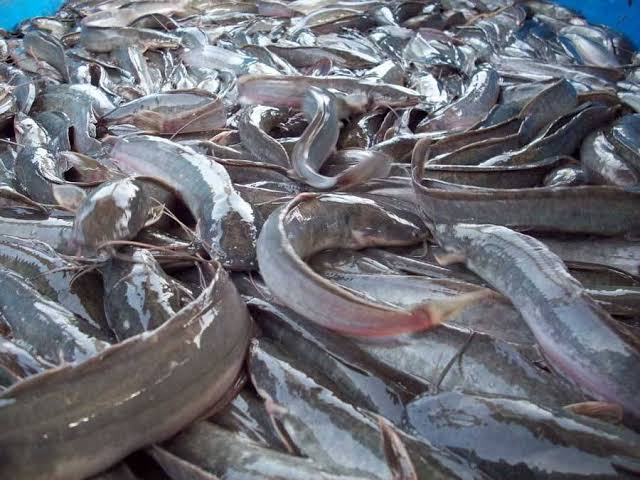

The Federal Government has secured a $200 million World Bank-backed financing commitment to expand fisheries and aquaculture production across Nigeria, as part of efforts to close the country’s annual fish supply deficit and reduce its nearly $1 billion import bill.
The Minister of Marine and Blue Economy, Dr Adegboyega Oyetola, said the funding would be made available to state governments as concessional loans to support fish farming, attract private investment, create employment and strengthen national food security.
Oyetola disclosed this through the Senior Special Assistant to the President on Marine and Blue Economy, Professor Busayo Fakinlede, at an executive training on the Aquaculture Investment Guide organised by the Federal Ministry of Marine and Blue Economy in partnership with the World Bank Group in Abuja.
According to the minister, Nigeria requires approximately 3.6 million tonnes of fish annually but produces only about 1.4 million tonnes, leaving a shortfall of more than 2.2 million tonnes, which is largely met through imports.
He said the country could no longer afford to depend heavily on imported fish when it possessed the natural resources and economic potential to meet a substantial proportion of its domestic demand.
“Fish is a pillar of food security, household nutrition and rural livelihoods. No nation can call itself food secure while it imports most of the fish it eats. Our ambition is to produce more, import less and, in time, become a net exporter. That ambition can be achieved only when every state plays its part,” Oyetola said.
He explained that the Federal Government was adopting a state-driven aquaculture development framework under which each state would identify its priority fisheries and aquaculture value chains, assess investment opportunities and develop commercially viable projects capable of attracting financing.
The minister said the $200 million facility would provide critical support for states to expand production capacity and accelerate Nigeria’s drive towards fish sufficiency.
He added that a Federal-State interface would be established to coordinate the national fish security strategy and ensure that government commitments translated into measurable production targets and investment outcomes.
The training attracted policymakers and government officials, including commissioners from Rivers, Bayelsa, Delta and Cross River states, as well as permanent secretaries and directors responsible for fisheries and aquaculture across the country.
Participants were trained to identify viable fish farming opportunities, attract investors and develop bankable projects. The programme also addressed business risk management, environmental and social safeguards, and partnerships with private investors.
Oyetola commended the World Bank Group for its support through research, investment planning, capacity building and the development of the Aquaculture Investment Guide.
He also pledged to sustain engagement with state governments, investors and other stakeholders, announcing plans for a post-training meeting to agree on implementation strategies and translate the proposals into actual investments.
In his remarks, Fakinlede attributed recent progress in the fisheries and aquaculture sector to the minister’s leadership, citing the inauguration of a Technical Committee on Accelerating Fish Production in August 2026 and the digitisation of fish import licensing.
He disclosed that Nigeria’s fish production had increased from 1.1 million tonnes to 1.4 million tonnes.
Fakinlede also highlighted Nigeria’s certification to export shrimp to the United States following compliance with Turtle Excluder Device requirements, as well as the development of the Fish City and Fish Terminal investment portfolio to attract private-sector participation.
He said the government’s ultimate objective was to close the domestic fish supply gap, create jobs, improve household incomes and reduce the country’s dependence on imported fish.
“Through strategic collaboration, contributive support and shared commitment, we will close the fish deficit, create jobs, raise household incomes and secure Nigeria’s place as a fish-sufficient nation,” he said.
A 2026 research report on Nigeria’s fisheries and aquaculture sector also identified high fish-feed costs, inadequate cold-chain infrastructure, post-harvest losses and limited access to finance as major constraints to expanding domestic production.
The report noted that fish feed accounts for between 60 and 70 per cent of aquaculture production costs, while inadequate storage and transportation facilities contribute to significant post-harvest losses.
The $200 million financing commitment is therefore expected to provide an opportunity to address some of the structural challenges confronting the sector. However, details of the disbursement timetable and the specific financing conditions for participating states have not yet been publicly outlined.









Leave a comment