

Belgian Prime Minister Bart De Wever returned home from the NATO summit in Turkey to an unexpected discovery after finding that his luggage contained a handgun and live ammunition presented as an official gift by Turkish President Recep Tayyip Erdoğan.
The unusual diplomatic souvenir was presented to world leaders at the close of Wednesday’s NATO summit in Ankara, where President Erdoğan gifted each visiting head of government a vintage Turkish-made revolver together with live ammunition, in what observers viewed as a showcase of Turkey’s expanding defence manufacturing industry.
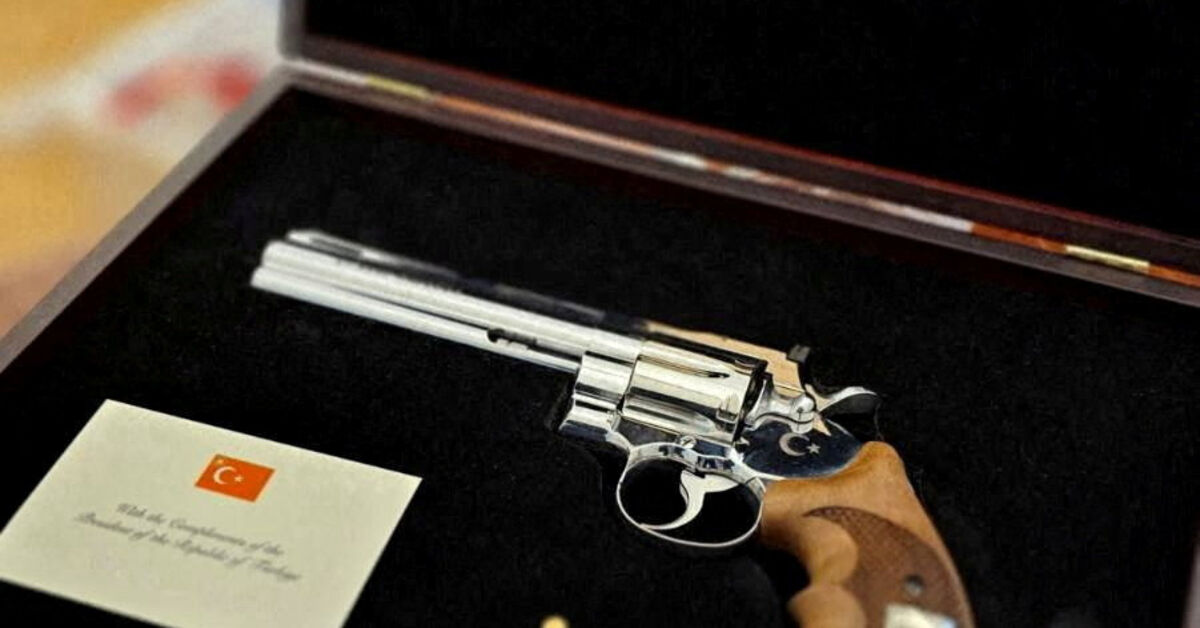
According to images released by the office of Lithuanian President Gitanas Nausėda, the gift appeared to be the Gümüşay .357 Magnum, a rare revolver manufactured by Turkish state-owned arms producer MKE during the 1990s.
The firearm was presented in a polished wooden display case bearing the Turkish flag, the NATO emblem and an inscription in both Turkish and English describing it as “Gümüşay, the first revolver-type handgun produced in our country”.
Officials said each revolver had been engraved with the recipient’s name, making the gift both personalised and symbolic.
Upon arriving in Belgium, De Wever handed the firearm to police at Brussels Airport, where it was secured in a safe in accordance with security regulations.
Other NATO leaders adopted varying approaches to handling the unexpected gift.
A spokesperson for Spanish Prime Minister Pedro Sánchez confirmed that all leaders had received the same revolver.
An aide to Polish President Karol Nawrocki said the firearm remained at Warsaw Airport awaiting customs clearance and would subsequently be stored securely.
“Certainly no one will be shooting it,” the aide told Radio RMF FM.
The offices of the Dutch and Swedish prime ministers said their respective revolvers had been transferred to their embassies in Ankara. Dutch authorities intend to have their firearm permanently deactivated, while Sweden is awaiting the completion of import formalities.
British Prime Minister Sir Keir Starmer reportedly received not only the revolver but also a cleaning kit and 500 rounds of ammunition, according to a Downing Street source.
Italian Prime Minister Giorgia Meloni’s firearm has already been placed in storage at the Palazzo Chigi in Rome alongside other official state gifts.
European Commission President Ursula von der Leyen is expected to donate her revolver to a military museum, while Greek Prime Minister Kyriakos Mitsotakis plans to present his to the War Museum in Athens.
Canadian Prime Minister Mark Carney struck a lighter tone, joking that his own diplomatic gift to President Erdoğan had been considerably less dramatic.
“It struck me that my gift of maple syrup kind of undermatched” the Turkish present, he remarked during a press conference.
Carney added that he had not personally seen the revolver and reassured Canadians that it had already been rendered inoperable.
“I would like to reassure Canadians – they keep guns away from me,” he said, noting that the firearm could eventually be donated to Canada’s national war museum.
The presentation of the revolvers highlighted Turkey’s growing ambitions within the global defence industry.
Although Turkey’s modern firearms sector primarily manufactures semi-automatic pistols, the Gümüşay revolver remains a relatively rare collector’s item, having been produced in limited numbers during the 1990s.
Turkish arms manufacturers have significantly expanded their presence in the international firearms market in recent years, particularly across Europe, where competitively priced pistols and shotguns have increasingly challenged long-established Italian and Belgian manufacturers.
According to the Geneva-based Small Arms Survey, Turkey ranked as the world’s third-largest exporter of small arms between 2019 and 2024, recording exports worth approximately 3 billion US dollars during the period, behind only the United States and Italy.
The presentation of firearms as diplomatic gifts has nevertheless attracted attention, with several leaders opting to place the revolvers in museums or secure government collections rather than retain them for personal possession.










Leave a comment