

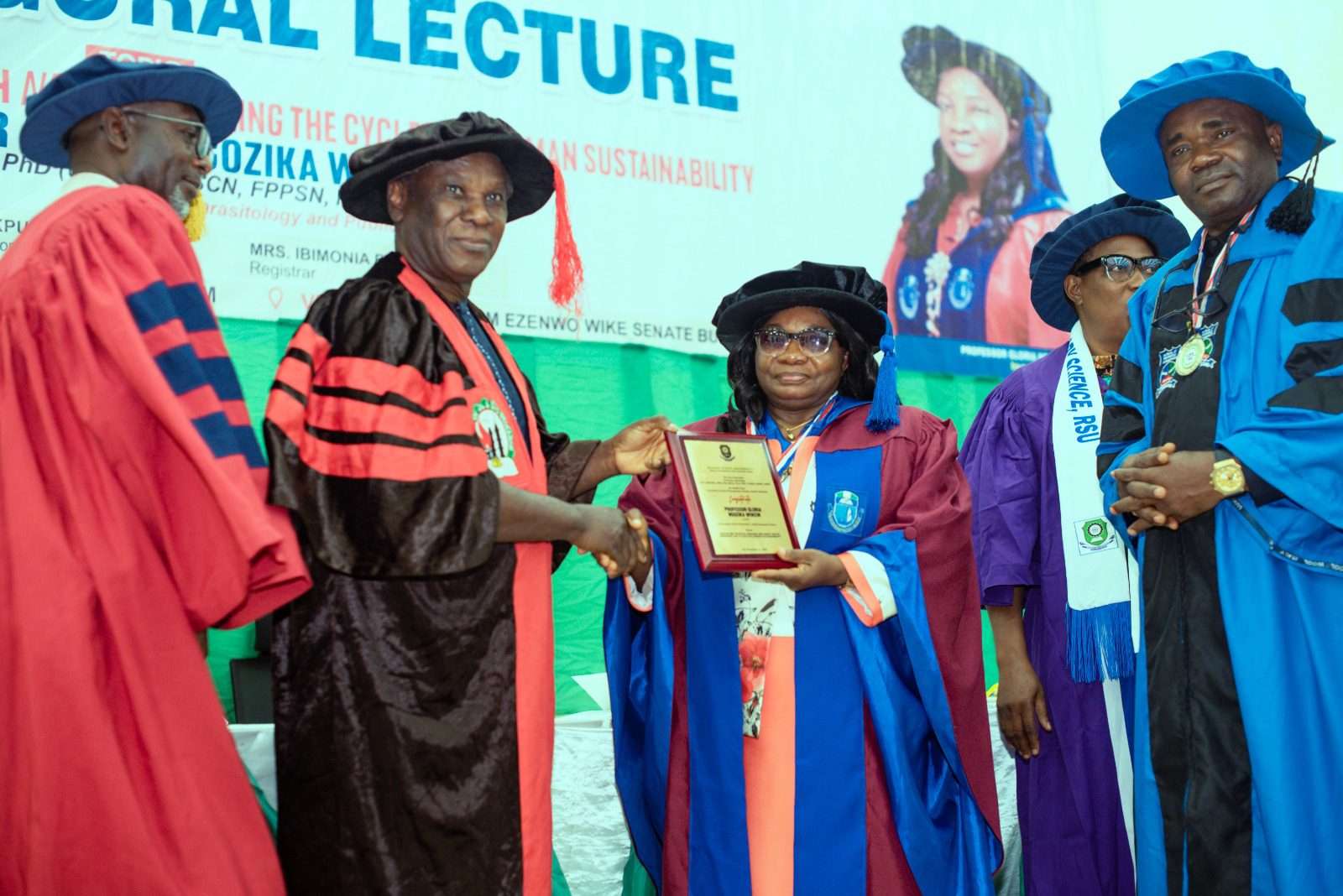

A Professor of Parasitology and Public Health at the Rivers State University (RSU), Professor Gloria Ngozika Wokem, has issued a compelling call for sweeping policy changes, demanding the compulsory incorporation of hygiene education into the primary and secondary school curriculum across Nigeria.
Professor Wokem made the urgent recommendation while delivering the University’s One Hundred and Twenty-Second (122nd) Inaugural Lecture, titled “Neglected Tropical Diseases and WASH Nexus: Breaking the Circles for Human Sustainability.”
Addressing a capacity audience, Professor Wokem argued that embedding hygiene education early in life is critical to reducing the spread of diseases associated with poor sanitation and hygiene practices.
“Teaching of hygiene should be made compulsory and incorporated into our educational curriculum,” Professor Wokem insisted. She added that functional facilities, such as wash hand basins with safe running water in offices and public places, are a necessity.
The expert stressed that the widespread prevalence of Neglected Tropical Diseases (NTDs) which afflict over 53 percent of developing countries and 57.3 percent of the global population is directly linked to inadequate Water, Sanitation, and Hygiene (WASH) infrastructure.
“The weather, temperature, and vegetation in the tropics support these diseases, and critically, safe water, sanitation, and hygiene are limiting in the tropics, which is why we are called developing countries,” she explained. According to the Professor, these afflictions impose poverty and hinder human development.
Beyond school curriculum reform, Professor Wokem strongly advocated for practical infrastructural changes, particularly in rural and riverine communities. She called for the abolition of the water-body latrine system and the provision of “alternative well located pit latrines.”
She emphasized that maintaining simple practices observed during the COVID-19 pandemic, such as frequent handwashing, must become a permanent cultural norm to effectively “break the circle of Neglected Tropical Diseases.”
Earlier in his remarks, the Vice Chancellor of the Rivers State University, Professor Isaac Zeb-Obipi, represented by the Provost of the College of Postgraduate Studies, Professor Tamunoene Simeon Abam, described the lecture as both timely and relevant.
Professor Obipi noted that the theme of the lecture aligns perfectly with the University’s ongoing commitment to promoting research-driven innovations that directly tackle critical, real-life societal problems, ensuring sustainable health outcomes for the community.









Leave a comment