
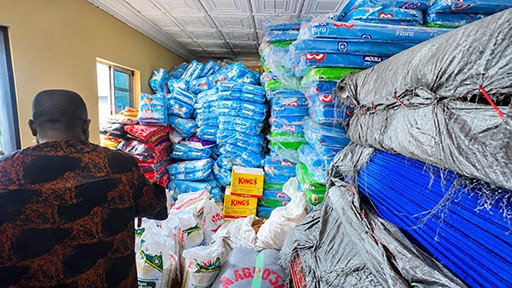

The South-South Development Commission (SSDC) has distributed humanitarian relief materials to residents of Bille Kingdom in Degema Local Government Area of Rivers State following persistent gas seepage and methane emissions that have raised serious environmental and public health concerns.
The intervention is aimed at alleviating the hardship confronting residents whose sources of drinking water, livelihoods and economic activities have been affected by the environmental crisis.
The relief distribution, initiated by the Commission’s Managing Director and Chief Executive Officer, Usoro Akpabio, was carried out by a delegation led by its Executive Director, Social Services and Human Capital Development, Preye Aganaba.
Speaking on the intervention, Akpabio assured the people of Bille that the Commission would not abandon them, stressing that their recovery remained a priority.
She described Bille as an important economic centre in Rivers State and the wider South-South region, noting that the environmental emergency had consequences beyond property damage, including disruption of businesses, threats to food security, displacement of families and loss of livelihoods.
Akpabio disclosed that the Commission provided 86 categories of food and non-food items, including rice, beans, garri, noodles, vegetable oil, mattresses, mosquito nets, buckets, sanitary pads and baby diapers.
She explained that the intervention was in fulfilment of President Bola Tinubu’s directive to the Commission to provide succour to vulnerable communities and accelerate development across the six South-South states.
“The plight of the people of Bille is of great concern to the Commission. Their recovery remains a priority, and we want to assure them that they will not be overlooked in our developmental agenda,” she said.
The SSDC managing director added that the intervention was designed to complement the efforts of Rivers State Governor, Siminalayi Fubara, the Rivers State Emergency Management Agency (RSEMA) and the National Emergency Management Agency (NEMA).
Speaking on behalf of the Bille Council of Chiefs, its Chairman, Chief Bennett Okpoke, expressed appreciation to the SSDC for responding to the community’s plight but urged the Federal and Rivers State Governments to go beyond the distribution of relief materials and urgently address the root cause of the gas seepage.
Okpoke said residents had endured prolonged gas and methane emissions, with devastating consequences for their water sources, health, livelihoods and daily activities.
He called on relevant government authorities and environmental regulatory agencies to intensify efforts towards containing the emissions and restoring the community’s environment.
Also speaking, NEMA’s Head of Operations for Bayelsa and Rivers States, Dr Chidi Ogundu, disclosed that the agency had conducted an Environmental Impact Assessment to determine the extent of the environmental damage, with findings indicating significant adverse effects on the community.
He said NEMA’s technical team had commenced efforts to address the potable water challenges confronting residents, particularly the contamination of existing water sources, to prevent further exposure to potential health hazards.
The relief materials were formally handed over to the community through NEMA and received by representatives of the Council of Chiefs of His Royal Majesty, King Igbikingeri Ngowari Cornelius Herbert, Agbaniye-Jike XVIII.
Meanwhile, the gas seepage crisis has continued to attract the attention of regulatory authorities, with the Nigerian Upstream Petroleum Regulatory Commission (NUPRC) previously acknowledging the seriousness of the situation and promising further technical investigations.
In July 2026, the NUPRC disclosed that preliminary investigations had indicated contamination of the first aquifer, raising concerns about the safety of underground water sources. The Commission also announced plans to engage an international firm to undertake further studies to establish the causes of the seepage and determine appropriate long-term solutions.
An earlier investigation by Premium Times, published in June 2026, traced the emergence of the gas seepage to abandoned oil and gas infrastructure, including old pumping facilities and shallow wells, where gas reportedly began bubbling to the surface in late 2025.
The investigation also raised concerns about the possible presence of methane, volatile organic compounds and hydrogen sulphide, alongside potential fire, explosion and public health risks.
NEMA had also distributed relief materials to affected residents in October 2026 as part of its initial humanitarian response to the emergency.
The latest SSDC intervention therefore represents another effort to cushion the impact of the crisis on the affected population.
However, beyond emergency assistance, residents are increasingly concerned about the need for a comprehensive environmental response that will identify and stop the source of the gas seepage, provide safe drinking water, assess possible health implications and restore their damaged livelihoods.
The unfolding situation has renewed calls for coordinated action by the Federal Government, the Rivers State Government, petroleum regulatory authorities and emergency management agencies to prevent further environmental degradation and protect the lives of residents of Bille Kingdom.
For the people of Bille, the distribution of relief materials offers temporary respite, but a permanent solution to the gas seepage remains their most pressing demand.











Leave a comment