
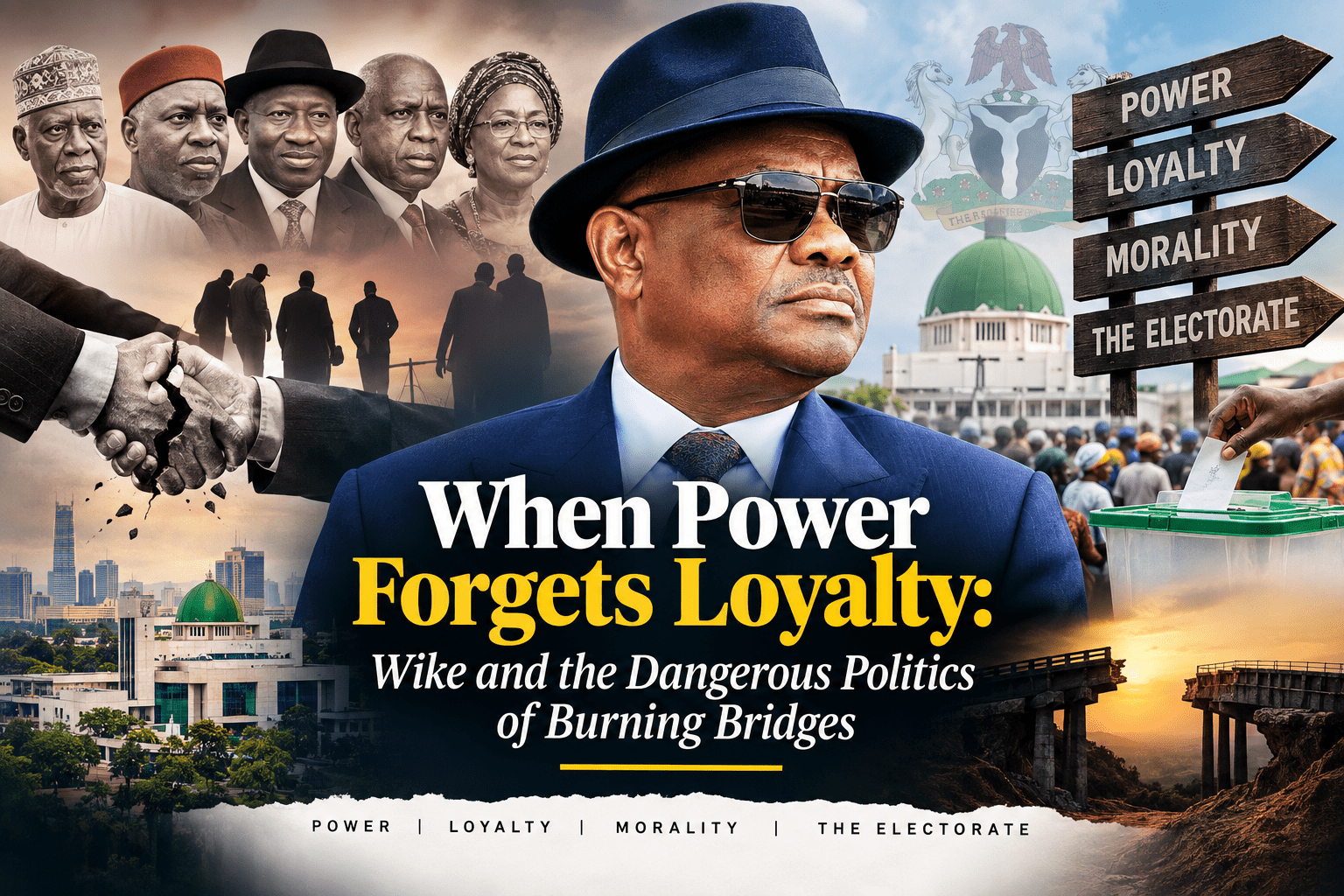

By Dr Gloria Boma Harry
There is a familiar maxim in Nigerian politics: “There are no permanent friends and no permanent enemies, only permanent interests.”
It is repeated so frequently that it has become almost a cliché. Politicians invoke it to explain changing alliances, broken relationships and unexpected political marriages. But behind this seemingly innocent maxim lies a troubling question: Can the pursuit of political interest become so relentless that loyalty, gratitude, morality and even old friendships become expendable?
That question is particularly relevant in the unfolding political drama surrounding former Rivers State Governor and current Minister of the Federal Capital Territory, Chief Nyesom Wike.
Politics is, undoubtedly, a contest for power. But no politician acquires power alone. Behind every successful political career are people who opened doors, offered opportunities, provided mentorship, mobilised support, made sacrifices and, sometimes, staked their own political capital on the success of another.
Political advancement is therefore rarely an individual journey. It is usually the product of a network. And networks create obligations.
The Price of Political Power
Power is the capacity to influence behaviour, shape decisions, control resources and determine outcomes. In leadership and organisational theory, power is commonly classified as legitimate, reward, coercive, expert, referent, informational and connection power. In politics, these forms of power frequently operate simultaneously.
Legitimate power comes from office. Reward power comes from the ability to distribute opportunities and patronage. Coercive power derives from the capacity to impose sanctions. Expert power comes from knowledge and competence. Referent power is built on personal reputation and influence. Informational power comes from access to valuable information.
But perhaps the most important form of political power is connection power: the ability to influence events through relationships and networks. This is where the story of Nyesom Wike becomes particularly fascinating.
Wike did not emerge from political obscurity and suddenly become one of Nigeria’s most formidable political actors. His rise was accompanied by relationships with influential political figures who, at different points, provided opportunities, mentorship, access and political platforms.
From his beginnings in Rumueprikom, he rose through the political hierarchy to become Chairman of Obio/Akpor Local Government Area, Chief of Staff to the Rivers State Governor, Minister of State for Education, Governor of Rivers State and, subsequently, Minister of the Federal Capital Territory.
That journey is not simply a story about individual determination. It is also a story about political networks and the power of relationships.
Among the figures associated with the political environment that shaped Wike’s rise were elder statesmen and influential political actors including Senator Azuta Mbata, Rt Hon. Chibuike Rotimi Amaechi, former President Goodluck Jonathan, Sir Peter Odili and Justice Mary Odili.
Whether one agrees with Wike’s politics or not, his political trajectory demonstrates an important reality: political power is accumulated through people before it is exercised through institutions.
From Mentorship to Political Rivalry
Yet, there is an uncomfortable paradox at the heart of Nigerian politics. The people who help build a political career can eventually become obstacles to the politician they helped create.
Alliances that once appeared unbreakable can collapse. Mentors can become rivals. Friends can become opponents. Political beneficiaries can eventually challenge their benefactors.
This is not peculiar to Wike. It is a recurring feature of Nigerian politics. But Wike’s case is particularly compelling because of the sheer scale of his political influence and the number of major political relationships that have, at different times, evolved from cooperation into confrontation.
The question is therefore not whether political interests change. They do. The question is whether political interest should completely erase political loyalty.
When Gratitude Becomes a Political Liability
Loyalty does not mean blind obedience. A politician should be free to disagree with a former mentor. Political disagreements are legitimate. Political interests change, and no individual should be expected to surrender personal convictions simply because someone once assisted them.
But there is a distinction between political independence and political ingratitude. There is also a distinction between disagreement and destruction. A politician can disagree without destroying. A politician can leave an alliance without humiliating former allies. A politician can pursue a different political ambition without treating every former friend as an enemy. This is where the moral dimension of political leadership becomes important.
If every relationship is viewed merely as a transaction: What can this person do for me today, and what can I gain from this relationship tomorrow?; then politics becomes little more than an endless marketplace of interests. And when politics becomes entirely transactional, loyalty becomes worthless.
The Odili Question
Recent developments surrounding PAMO University of Medical Sciences have inevitably brought the relationship between Wike and the Odili family back into public discussion.
The Rivers State House of Assembly removed a proposed ₦6 billion allocation to PAMO University from the state’s 2026 budget amid questions concerning funding and accountability. The university was founded by former Governor Peter Odili, while the scholarship arrangement involving Rivers State and the institution dates back to the Wike administration.
The Assembly has presented the issue primarily as one of accountability and public finance. That explanation deserves to be examined on its merits. However, politics is not conducted in a vacuum.
When a major public-finance decision involving an institution founded by a former political benefactor occurs within the context of a broader political disagreement, people will inevitably ask whether politics has entered the equation. That question should not be dismissed.
But neither should political suspicion be automatically treated as proof. The appropriate response is transparency. If public money is involved, the people of Rivers State deserve to know how it is being spent, why it is being spent and whether the beneficiaries are receiving value. The issue should ultimately be bigger than Wike and Odili. It should be about the public interest.
Amaechi: From Political Ally to Fierce Rival
Then there is Chibuike Rotimi Amaechi. Few political relationships in Rivers State have undergone a more dramatic transformation. The relationship between Amaechi and Wike once represented one of the most formidable political alliances in the state. Today, the two occupy opposite ends of a political rivalry that has extended far beyond Rivers State.
The recent controversy surrounding Amaechi’s mother’s burial and a civic reception organised for Wike on the same day again demonstrated the extraordinary intensity of their political rivalry.
For many observers, the episode was more than a scheduling coincidence. It became another chapter in a political relationship that has travelled from alliance to confrontation.
But perhaps the bigger lesson is this: Political bridges are easier to burn than to rebuild. Once destroyed, relationships built over decades may not be recoverable. And politics, unlike ordinary life, has a long memory.
The Wike Question
So, has Nyesom Wike become so powerful that political relationships are now primarily viewed through the prism of transactions?
Is political loyalty valuable only for as long as it produces political returns? Has the pursuit of influence become more important than preserving relationships that helped create that influence in the first place?
These are uncomfortable questions, but they are legitimate questions.
Wike is unquestionably a powerful political figure. His influence extends beyond Rivers State, and his national political profile has made him an important actor in the politics surrounding the 2027 elections.
But political power contains within it a dangerous illusion; the belief that today’s strength is permanent.
It is not. No politician remains permanently powerful. No political structure remains permanently dominant. No alliance remains permanently secure. And no political kingmaker can completely control what the next generation of politicians will become.
History is littered with political giants who once appeared invincible. Eventually, the political landscape changed.
And What About Tinubu?
This brings us to another question. Could the political alliances and networks being constructed today eventually become a challenge to President Bola Ahmed Tinubu before the 2031 elections?
I may be wrong. Indeed, political predictions in Nigeria are notoriously difficult. Political alliances can change overnight. Friends can become enemies, enemies can become allies, and yesterday’s political calculations can become irrelevant tomorrow.
But there is a lesson that should not be ignored. The political structures created to serve one ambition can eventually serve another.
Every political network has a life beyond its immediate purpose. That is why President Tinubu must be careful.
My candid advice to the President is not to fear political opponents but to protect the democratic system that gives political competition legitimacy. Opposition parties must be allowed to operate freely. Political actors should be able to organise without intimidation.
Electoral institutions must be protected from partisan manipulation. Government agencies must serve the Nigerian people rather than individual political interests. And the Constitution of the Federal Republic of Nigeria must remain superior to the ambitions of every individual politician.
Because presidents leave office. Governors leave office. Ministers leave office. Political parties rise and fall. But the Nigerian state remains.
The Electorate Must Come First
There is another group often forgotten in the endless battle between political heavyweights: the electorate.
While politicians are negotiating alliances, building structures and calculating their next political moves, ordinary Nigerians are struggling with the realities of everyday life.
They want good schools. They want functional hospitals. They want security. They want employment.They want roads. They want affordable food. They want an economy that gives their children a future.
They are less interested in who defeated whom in the latest political confrontation than in whether government works.
That is why political power must ultimately be measured not by the number of political enemies defeated but by the quality of institutions left behind.
The true legacy of a politician should not be the number of people he controlled. It should be the number of lives he improved.
Power Is Temporary. Legacy Is Permanent.
There is nothing inherently wrong with ambition. Ambition drives political leadership. There is nothing inherently wrong with political strategy. Strategy is essential to political survival. There is nothing inherently wrong with changing alliances.Circumstances change.
But there must be a line that ambition cannot cross. That line is the protection of democratic institutions. Political rivalry should never become an excuse for institutional destruction. Political disagreement should never become persecution.
Loyalty should never mean surrendering one’s conscience. And political power should never become a licence to treat people as disposable instruments. Nigeria needs politicians who understand that power is a responsibility, not a possession.
Wike’s political journey offers a profound lesson in this regard. The same relationships that help build power can eventually become the relationships that define a politician’s legacy.
The question is not merely how much power a politician can accumulate. The more important question is what he does with that power and what remains after the power is gone.
There are indeed no permanent friends and no permanent enemies in politics. But perhaps there should be something permanent after all: Permanent principles. Permanent respect for democracy. Permanent respect for the Constitution. Permanent commitment to the electorate. And a permanent understanding that no political ambition is worth destroying the country we all hope to lead.
After all, no individual’s political aspiration should ever be worth a single drop of Nigerian blood.
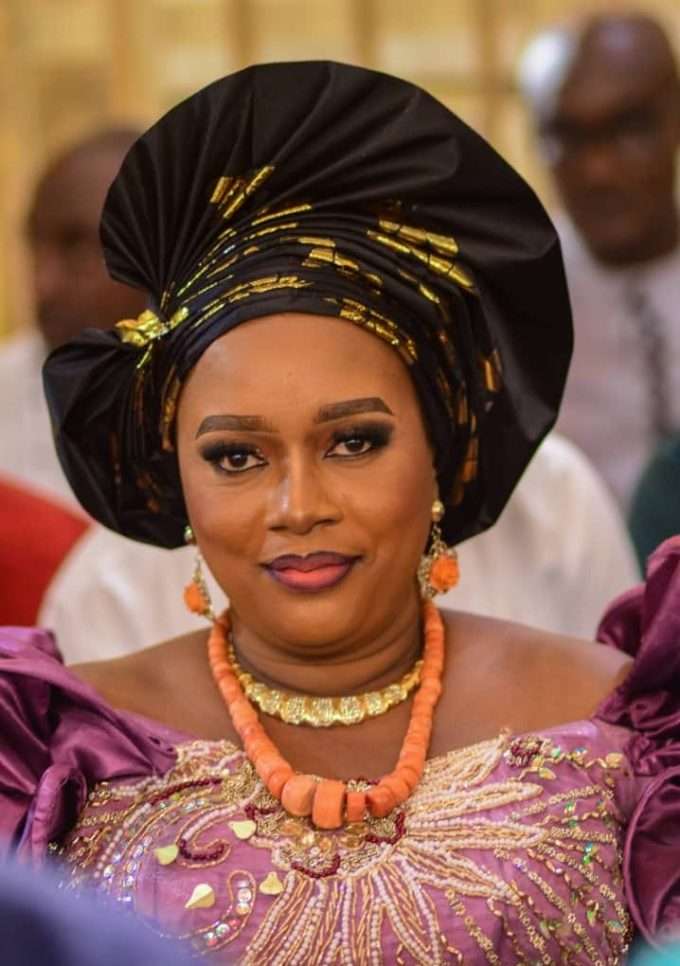
Dr Gloria Boma Harry writes from Port Harcourt, Rivers State. Email: gloriab4real@gmail.com




Leave a comment