
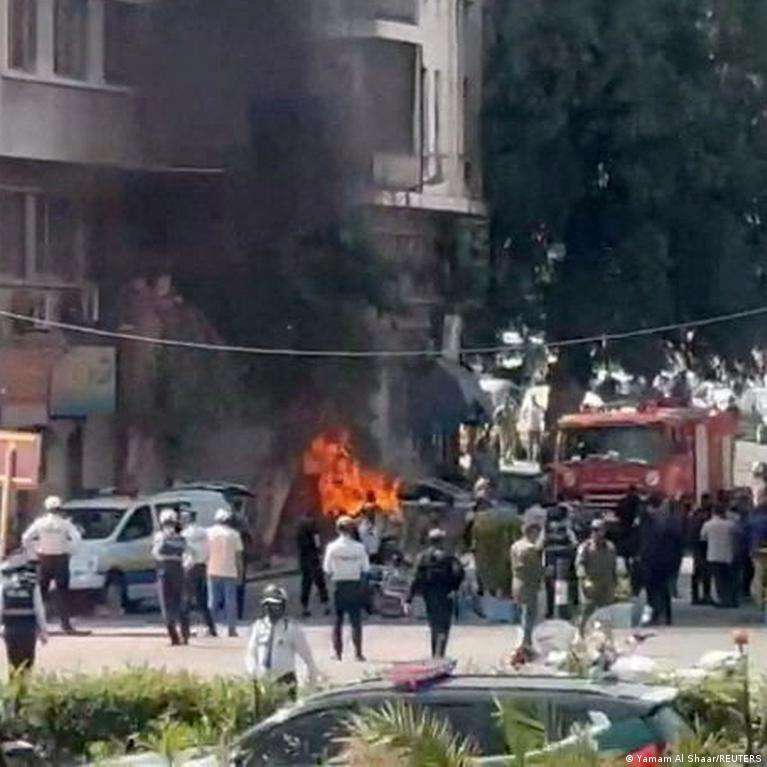

Two explosions occurred near the Four Seasons Hotel in Damascus on Tuesday, injuring 18 people, while French President Emmanuel Macron was on an official visit to Syria, according to Syrian authorities and French media.
President Macron, who had spent the previous night at the Four Seasons Hotel ahead of high-level talks with Syrian President Ahmed al-Sharaa, was already at the Presidential Palace when the explosions occurred and was not harmed, the Élysée Palace confirmed.
French broadcaster BFMTV reported that the French leader had been staying at the hotel, which is frequently used by foreign diplomats, humanitarian workers, journalists and other international visitors to Syria.
According to Syria’s state-run Syrian Arab News Agency (SANA), the twin explosions occurred while security personnel were attempting to dismantle explosive devices. The blasts left 18 people injured, including four police officers, while authorities have launched an investigation into the incident.
Syria’s state television channel, Al Ekhbariya, citing Interior Minister Anas Khattab, reported that the two explosions occurred approximately eight minutes apart. Khattab added that President Macron’s convoy was around 10 kilometres from the blast site at the time of the incident.
Shortly after the explosions, Macron reaffirmed France’s support for Syria’s future in a message posted on X.
“Nothing can smother the aspiration of Syrian women and men to live in a fully sovereign, safe, pluralistic, and united Syria,” the French President wrote.
Although the post did not directly refer to the explosions, it underscored France’s continued commitment to Syria’s political transition.
President Ahmed al-Sharaa condemned the attack and vowed that those responsible would be apprehended swiftly.
“Those involved will be arrested as soon as possible,” he said, while commending Macron for proceeding with his official engagements despite the security incident.
“I salute President Macron’s courage in continuing the visit,” the Syrian leader added.
The explosions occurred less than a week after another deadly attack in Damascus claimed the lives of nine people and left 22 others injured, according to Syria’s Ministry of Health, highlighting continuing security concerns in the capital.
Macron’s visit marks a significant diplomatic milestone, making him the first Western leader to undertake an official visit to Syria since the fall of the Assad regime in December 2024. He is only the third serving head of state to visit the country during the post-Assad period, following the Emir of Qatar and Ukrainian President Volodymyr Zelensky.
Receiving Macron at the Presidential Palace, Al-Sharaa hailed what he described as “the new Syria”, portraying the country as one determined to rebuild after years of conflict.
He emphasised Syria’s readiness to strengthen international partnerships and highlighted opportunities for investment and economic cooperation during a meeting attended by French and Syrian delegations, including senior figures from the energy and maritime sectors.
“Syria has a strategic location linking the Mediterranean with the Gulf and Iraq, and is only a few hours by sea from Marseille,” Al-Sharaa said.
“Following the Strait of Hormuz crisis, the world recognised the value of safe and stable trade corridors here,” he added.
The visit also produced tangible diplomatic outcomes, with Syrian Foreign Minister Asaad al-Shaibani and French Foreign Minister Jean-Noël Barrot signing a series of agreements aimed at enhancing economic cooperation between the two countries, according to SANA.
Macron and Al-Sharaa are expected to travel to Ankara for the forthcoming NATO summit, where the Syrian President is also scheduled to hold talks with United States President Donald Trump on the sidelines of the gathering, according to the White House.
The Damascus explosions nevertheless served as a stark reminder of the fragile security environment that continues to confront Syria, even as the country’s new leadership seeks to deepen international engagement and attract foreign investment in its reconstruction efforts.




Leave a comment